



Car Suspension Diagnosis helps identify noise, vibration, and handling issues. Get expert tips and solutions for accurate Car Suspension Diagnosis today.
When you drive down a bumpy road, hit a pothole, or take a sharp turn, your car does not shake apart or throw you out of your seat. Why? Because of a brilliant system hidden under your vehicle: the suspension.
Think of your car’s suspension as the legs and knees of a human body. Without them, every tiny rock would feel like a mountain. Your suspension system is the silent hero that gives you a smooth, comfortable, and safe ride. But like any hero, it can get tired, worn, and broken over time.
At Shujha Auto Garage Services, we have seen thousands of cars with car suspension problems. Some drivers ignore the warning signs for months, only to end up with a much bigger (and more expensive) repair bill later.
I will walk you through everything you need to know. We will talk about the signs of a bad suspension, the common causes, how a proper suspension system diagnosis works, and finally, how we fix it. I will also answer the three questions every car owner asks: What happens if an issue is found? Are there any hidden fees or charges? What’s included in the free diagnostic check?
Let’s dive in. Your car will thank you.
What Does Your Car’s Suspension Actually Do?
Before we talk about problems, let us understand the job of this system. Many drivers think suspension is just about comfort. That is only half the truth.
Your vehicle’s suspension has three main jobs:
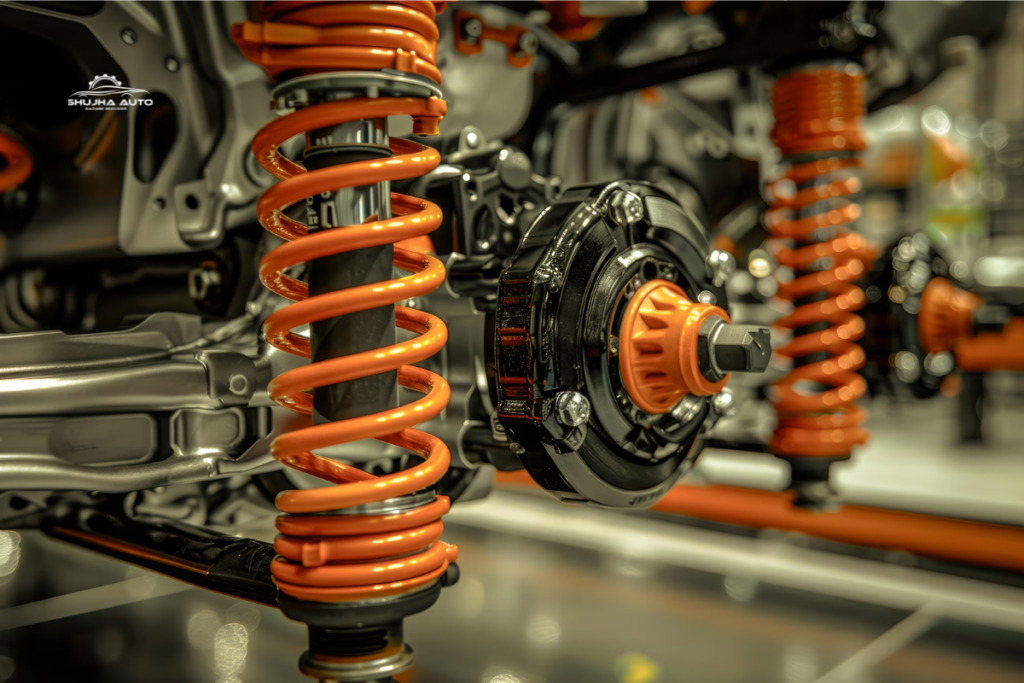
- Absorb Shocks: When you drive over a speed bump or a pothole, the suspension parts (springs and shock absorbers) soak up the energy so that the car body does not bounce wildly.
- Keep Tires on the Road: This is the most important safety job. A good suspension pushes your tires down onto the road surface at all times. If your tire leaves the road for even a second, you lose steering control and braking power.
- Stability During Turns: When you turn left or right, the suspension stops your car from rolling over too much. It keeps you level and in control.
So, when car suspension problems start to appear, you are not just losing comfort. You are losing control, safety, and money (because bad suspension damages your tires faster).
7 Clear Signs of Car Suspension Problems (Don’t Ignore These)
How do you know if your suspension is failing? You do not need to be a mechanic. Your car will tell you. You just need to listen and feel.
Here are the seven most common signs of car suspension problems that we see daily at Shujha Auto Garage Services.
Sign #1: The Bumpy Ride That Never Ends
You know your neighborhood road. It has a few small bumps. But suddenly, every tiny crack in the asphalt feels like a giant hole. Your coffee cup shakes, your back hurts, and you feel every single pebble.
This is the number one sign. If your car feels like a wooden wagon instead of a modern vehicle, your shock absorbers or struts are likely worn out. They cannot absorb the shock anymore.
Sign #2: The Nose Dive When Braking
Here is a simple test. Drive at a slow speed (around 20 km/h) on a straight, empty road. Press the brake pedal firmly but gently. Watch what happens to the front of your car.
Does the front end dip or dive down heavily? If it feels like the car is bowing to the ground, your front suspension is weak. A healthy car should stay mostly level when braking. A nose dive means your shocks are failing.
Sign #3: The Rear Squat When Accelerating
Now try the opposite. From a stop, press the gas pedal to accelerate normally. Look in your rearview mirror (or ask a friend to watch from outside).
If the back of your car sinks down like a dog sitting, you have a problem. This rear squat means your rear suspension cannot handle the power going to the wheels. It makes your car unstable, especially at highway speeds.
Sign #4: Swerving or Swaying in Wind
Do you feel like you are driving a boat instead of a car? When a truck passes you on the highway, does your car sway left and right? When there is a strong wind, do you have to fight the steering wheel to stay in your lane?
That is called body roll. Too much body roll is dangerous. Your suspension is supposed to keep you stable. If it fails, a gust of wind could push you into another lane.
Sign #5: Uneven or Rapid Tire Wear
Go out to your car right now. Look at your tires. Do you see one side of the tire worn down more than the other? Do you see patches of bald spots? Do you see cupping (wavy, scoop-shaped wear)?
Tires do not wear out evenly for no reason. Bad suspension causes tires to bounce off the road. That bouncing creates strange wear patterns. If you keep replacing tires but the wear is always uneven, your suspension is the real problem.
Sign #6: Leaking Fluid on the Shocks
This one requires a quick visual check. Crouch down and look at the metal tubes behind each wheel. Those are your shock absorbers or struts. Do you see wet, oily residue running down the side? Is there dirt stuck to an oily film?
Shocks are filled with hydraulic fluid. When the seals break, the fluid leaks out. Without fluid, a shock is just a metal pipe. It does nothing. If you see leaks, replacement is needed.
Sign #7: Clunking, Knocking, or Squeaking Noises
Finally, listen to your car. When you drive over a speed bump slowly, do you hear a clunk or knock? When you turn the steering wheel while parked, do you hear a creak or squeak?
These sounds are not normal car noises. They are the sounds of metal parts that are loose, broken, or dry. Common culprits include worn ball joints, broken bushings, or damaged sway bar links.
If you notice any of these seven signs, do not wait. The problem will only get worse. Bring your car to Shujha Auto Garage Services for a proper suspension system diagnosis.
Location: Please Visit Our Shujha Auto Garage
What Causes Car Suspension Problems?
Why does suspension fail? It is not random. There are clear reasons. Knowing the causes can help you prevent future problems.
Cause 1: Normal Wear and Tear
Every part of your car has a lifespan. Suspension parts are made of rubber and metal. Rubber bushings dry out and crack after 5-7 years. Shocks lose their gas pressure after 80,000 to 100,000 kilometers. This is normal. Nothing lasts forever.
Cause 2: Bad Roads and Potholes
We cannot control the roads. But we can understand the damage. Hitting a deep pothole at speed sends a massive shock through your suspension. One bad pothole can bend a wheel, break a spring, or blow a shock seal. If you drive on dirt roads, cobblestones, or construction zones daily, your suspension will wear out faster.
Cause 3: Overloading Your Car
Your car has a maximum weight limit. It is written on a sticker inside the driver’s door. Every time you carry five passengers plus heavy luggage, you are pushing your suspension to its limit. Doing this for months or years will crush your springs and overheat your shocks.
Cause 4: Old Age of Rubber Parts
Remember rubber bushings? They are small, but they are critical. They act as cushions between metal parts. Over time, heat, oil, and ozone destroy rubber. Once the rubber cracks, the metal parts start banging against each other. That is when you hear the clunking noises.
Cause 5: Accidents and Curb Impacts
Even a small fender bender can bend a suspension component. Hitting a high curb while parking can knock your wheel alignment off by a lot. What seems like a minor bump can actually cause hidden damage that grows worse over time.
At Shujha Auto Garage Services, we always tell our customers: Prevention is cheaper than repair. A simple vehicle suspension inspection once a year can catch these causes early, before they become expensive disasters.
How Does a Professional Suspension System Diagnosis Work?
Now, let me take you behind the scenes. When you bring your car to us at Shujha Auto Garage Services for a suspension system diagnosis, what exactly do we do?
We do not just look at the car. We follow a proven, step-by-step process.
Step 1: The Visual Inspection (No Tools Needed First)
Our technician walks around your car. He looks at:
- How the car sits (is one corner lower than the others?)
- The condition of each tire (uneven wear is a big clue)
- Any visible leaks on the shocks or struts
- Broken or sagging springs
Step 2: The Bounce Test
We press down on each corner of your car (front left, front right, rear left, rear right) with our body weight. Then we release. A good suspension should bounce back up and stop immediately. If the car keeps bouncing up and down 2-3 times, the shocks are dead.
Step 3: The Road Test (Driving the Car)
We take your car for a short drive on a route that has bumps, turns, and a smooth highway section. While driving, we listen for noises, feel for vibrations, and test braking and acceleration behavior. This is where we confirm the signs you have been feeling.
Step 4: The Lift Inspection
We raise your car on a hydraulic lift. Now we can see everything underneath. We check:
- Ball joints: We wiggle each wheel to feel for looseness.
- Tie rods: These connect your steering to the wheels. If they are loose, steering becomes dangerous.
- Control arm bushings: We look for cracks, tears, or separation.
- Sway bar links: We shake them by hand. Any clunk means replacement.
- Shock absorbers: We check for leaks and test their resistance.
Step 5: The Measurement (If Needed)
For serious issues, we use precision tools to measure angles and distances. This tells us exactly which part is bent or worn beyond spec.
By the end of this process, we have a complete map of your suspension health. We know exactly what is working, what is worn, and what is broken.
What Happens If an Issue Is Found? (Answered Clearly)
This is the most common question we get at Shujha Auto Garage Services. You are worried. You think: If they find a problem, will I be forced to pay a huge amount right now?
Let me give you a straight, honest answer.
Step 1: We Explain Everything to You
If our suspension system diagnosis finds an issue, we do not just hand you a bill. We sit down with you. We show you the worn part on your actual car (or on a tablet with photos). We explain in simple words:
- What the part is supposed to do
- What is wrong with it
- Why it is a problem for your safety
- How urgent the repair is (can it wait 1 month? Or is it dangerous to drive today?)
Step 2: We Give You Options, Not Pressure
Not every issue needs an immediate fix. We categorize problems into three levels:
- Critical (Fix now): Your car is unsafe. Broken spring, failed ball joint, leaking brake fluid from a shock. Driving further could cause an accident.
- Moderate (Fix soon, within 2-4 weeks): Worn bushings, slight fluid leak, uneven tire wear starting. You can drive carefully, but do not delay.
- Minor (Monitor): Very early wear, no performance loss yet. We note it and will check again at your next service.
Step 3: You Get a Written Quote
We provide a clear, written estimate. It lists every part needed, the labor time, and the total cost. No surprises. You are free to say yes or not today. There is no pressure, no hidden sales pitch.
Step 4: If You Approve, We Fix It with a Warranty
If you say yes, we order quality parts (we offer economy, standard, and premium options). We do the repair. And we guarantee our work. Most suspension repairs come with a 12-month or 20,000 km warranty.
What if you cannot afford the repair today? No problem. We will give you a safety report. We will tell you exactly what to avoid (like highways or heavy loads). And we will keep your quote valid for 30 days. You can come back when you are ready.
So to answer clearly: When an issue is found, you are in control. You get the truth, you get options, and you get no pressure. That is the Shujha Auto Garage Services promise.
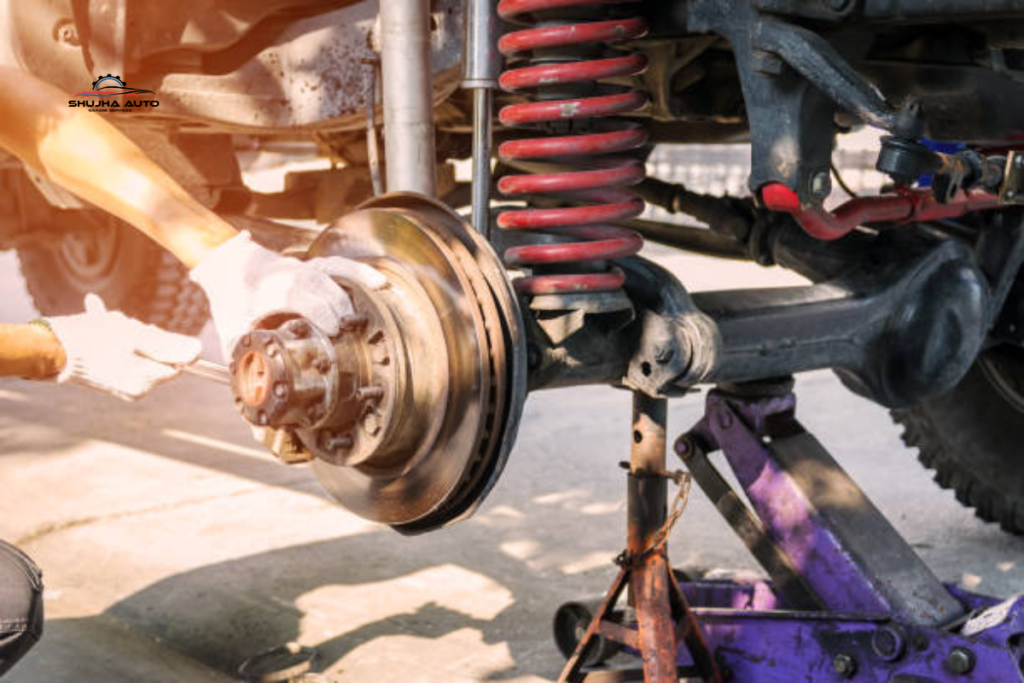
Are There Any Hidden Fees or Charges? (Straight Talk)
I know why you are asking this. You have been to other garages before. You dropped your car for a free check, and then suddenly there was a diagnostic fee or shop supplies charge or environmental fee on the bill.
Let me be 100% transparent.
At Shujha Auto Garage Services, there are NO hidden fees or charges for our standard diagnostic check.
Here is exactly what is included in our free check (more on that in the next section). And here is what you will NEVER see on our invoice:
- No diagnostic fee – We do not charge you to look at your car.
- No minimum labor charge – If we do not do a repair, we do not charge labor.
- No shop supply fee – Gloves, rags, and cleaner are our cost, not yours.
- No environmental disposal fee for a diagnosis – That only applies if we change oil or fluids.
- No admin fee – We do not charge you for printing a paper.
The only time you pay is if you approve a repair. And even then, every single cost is listed in your quote before we touch a single bolt.
But let me be honest about one thing: If you ask for a very advanced test (like a full geometry scan using a 3D alignment machine, or a suspension vibration analysis using sensors), there may be a small fee. Why? Because those machines cost tens of thousands of dollars to buy and maintain. But we will always tell you about that fee before we do the test. No surprises.
For 99% of drivers, the free visual and mechanical inspection is more than enough to find all major car suspension problems.
So again: No hidden fees. No hidden charges. Just honest work.
What’s Included in the Free Diagnostic Check? (Full List)
This is your most valuable question. You want to know exactly what you get for free. I will give you the complete list.
When you bring your car to Shujha Auto Garage Services for a free vehicle suspension inspection, here is everything we do at no cost to you:
1. Visual Exterior Inspection
- Check ride height (if one corner is lower than others)
- Inspect all four tires for uneven wear, cupping, or bald spots
- Look for fluid stains on shocks and struts
- Examine coil springs for visible cracks or breaks
2. Manual Bounce Test (All Four Corners)
- Push down and release each corner
- Observe rebound behavior (should stop in 1 bounce)
- Compare left vs right side (should feel the same)
3. Steering and Handling Check (While Parked)
- Turn steering wheel lock-to-lock while listening for noises
- Check for excessive free play in steering wheel
4. Under-Vehicle Lift Inspection (The Most Important Part)
- Raise the car on a professional lift
- Ball joint check: Pry bar test for up/down movement
- Tie rod check: Shake wheels left/right to feel for looseness
- Control arm bushings: Visual check for cracks, tears, or separation from metal
- Sway bar links: Manual shake test – any clunk means replacement
- Shock absorbers: Check for oil leaks and test shaft for smooth movement
- Rubber boots: Inspect CV boots and steering rack boots for tears
- Subframe bolts: Quick check for tightness (loose bolts cause wandering)
5. Brief Road Test (If Requested)
- We will drive your car around the block (with your permission)
- Listen for clunks, squeaks, or rattles
- Feel for pulling, swaying, or excessive bouncing
- Test braking for nose dive
6. Verbal Report + Written Summary
- We explain what we found in simple English
- We give you a written checklist with notes (keep it for your records)
- We mark items as: Green (Good), Yellow (Monitor), Red (Needs repair)
- We tell you the urgency level for each red item
7. No-Obligation Quote for Any Repairs
- If we find anything, we provide a written estimate
- You are free to take the quote and get a second opinion (we encourage it!)
- No pressure to book the repair today
What is NOT included in the free check?
To be fair, let me tell you what is not free:
- Full 3D wheel alignment (that is a separate service)
- Removal of parts to inspect hidden components (if a part must be removed, we will ask your permission first)
- Diagnostic scan for electronic suspension systems (some luxury cars have computer-controlled suspension – that scan takes 30 minutes and has a small fee)
But for a standard family car, hatchback, sedan, or SUV – the free check covers 95% of all car suspension problems.
How We Fix Common Suspension Problems (Simple Fixes)
Once we complete the suspension system diagnosis, we move to fixes. Here are the most common repairs we do at Shujha Auto Garage Services and how we do them.
Fix #1: Replacing Worn Shock Absorbers or Struts
The problem: Bumpy ride, nose dive, leaking fluid.
The fix: We remove the old shock/strut unit. We install a new one. Then we tighten all bolts to the exact factory specification (not too loose, not too tight). We always replace shocks in pairs (both front or both rear) so the car stays balanced.
Time needed: 1.5 to 3 hours depending on the car.
Fix #2: Replacing Broken Coil Springs
The problem: One corner of the car is sagging. You hear a loud clunk over bumps.
The fix: We lift the car, compress the spring safely (springs hold a lot of energy – dangerous if done wrong), remove the broken spring, and install a new one. Again, we replace in pairs (both front or both rear).
Time needed: 2 to 4 hours.
Fix #3: Replacing Worn Ball Joints
The problem: Clunking noise from front wheels, loose steering, uneven tire wear.
The fix: We remove the old ball joint (sometimes it is pressed into the control arm). We press in a new one. Then we check the wheel alignment because a new ball joint changes angles.
Time needed: 1 to 2 hours per side.
Fix #4: Replacing Sway Bar Links and Bushings
The problem: Rattling or clunking sound when driving over small bumps at low speed.
The fix: This is one of the easiest repairs. We unbolt the old plastic or metal links, bolt in new ones. The bushings are also simple to swap. Parts are inexpensive.
Time needed: 30 to 60 minutes.
Fix #5: Replacing Control Arm Bushings
The problem: Clunking, vague steering, wandering on the highway.
The fix: This is more labor-intensive. We remove the entire control arm, press out the old rubber bushings, press in new polyurethane or rubber bushings, and reinstall. Sometimes it is cheaper to replace the whole control arm with new bushings pre-installed. We will give you both options.
Time needed: 2 to 4 hours per side.
After any suspension repair that changes ride height or angles, we strongly recommend a wheel alignment. Why? Because new parts will change how your tires touch the road. Without alignment, your new suspension will wear out faster and your tires will be ruined in months.
Why Choose Shujha Auto Garage Services for Your Suspension?
You have many choices. There are big chain shops, small roadside mechanics, and even DIY if you have tools. But here is why thousands of drivers trust us with their car suspension problems:
1. We Speak Simple Language
We do not use confusing mechanic talk. We do not say your strut mount bearing has axial play. We say: This top part of your front suspension is loose. It will make a noise when you turn. Here is what we can do.
2. We Show You the Problem
We never ask you to trust us blindly. We bring you to the lift. We point to the broken part. We let you touch the leaking fluid. Seeing is believing.
3. Fair, Upfront Pricing
Our quotes are detailed. Part cost: X. Labor time: Y hours at Z rate per hour. Total: W. No miscellaneous line items. No surprise fees.
4. Quality Parts with Warranty
We offer three tiers:
- Economy: Good for older cars on a budget (6-month warranty)
- Standard: Best value for daily drivers (12-month warranty)
- Premium: OEM-quality or better (24-month warranty)
You choose. We do not force the expensive option.
5. We Value Your Time
Most suspension diagnostics take 30-45 minutes. Most repairs are done on the same day if you arrive early. We have a clean waiting area with WiFi and coffee. Or you can drop your car and we will call you when it is ready.
6. Hundreds of Happy Customers
We have fixed suspension issues on every make and model: Toyota, Honda, Suzuki, Hyundai, Kia, Ford, Nissan, Mitsubishi, and more. Our Google reviews and word-of-mouth referrals are our best marketing.
Frequently Asked Questions (FAQ)
Let me answer a few more quick questions we hear every week.
Q: How often should I get a vehicle suspension inspection?
A: Once every 12 months or every 20,000 kilometers. If you drive on bad roads often, make it every 6 months.
Q: Can I drive with a bad suspension?
A: Technically yes, but it is not safe. A bad suspension increases your stopping distance, reduces tire grip, and can cause a loss of control in an emergency. You are risking your safety and the safety of others.
Q: Will a bad suspension damage other parts of my car?
A: Yes. Bad shocks destroy tires in 6 months (tires are expensive). Bad ball joints can break completely and cause a wheel to fall off. Bad springs can puncture a tire. Fix small problems early to avoid big bills later.
Q: Do I need an appointment for the free diagnostic check?
A: Appointments are preferred because we get busy. But we always try to help walk-ins. Call us first to check availability.
Q: What brands of suspension parts do you use?
A: We use trusted brands like KYB, Monroe, Bilstein, Sachs, TRW, and Moog. We never use unknown no-name parts.
A Real Story – How We Saved a Customer’s Car (And Maybe Their Life)
Let me end with a true story from last month.
A young father brought his family SUV to Shujha Auto Garage Services for a routine oil change. He did not complain about the suspension. He said: Just the oil change, please.
But our technician noticed the front left tire was worn down to metal wires on the inside edge. That is a serious red flag. We asked for permission to do a free vehicle suspension inspection.
During the inspection, we found:
- A completely broken front left coil spring (it had snapped into two pieces)
- A blown front right shock absorber (covered in oil)
- Both front lower ball joints had excessive play (1/4 inch of movement)
We brought the customer to the lift. We showed him the broken spring. We explained that if that broken spring shifted while driving, it could puncture the tire at highway speed, causing a sudden blowout. His two young children sat in the back every day.
He was shocked. He had no idea. He approved the repair that same day.
After replacing both front springs, both front shocks, and both front ball joints, the SUV drove like a new car. The customer wrote us a thank-you note. He said: You didn’t just fix my car. You probably saved my family.
That is why we do this work. Not for money. Not for fame. But to keep you and your family safe on the road.
Conclusion: Your Next Step
You have now learned:
- The 7 signs of car suspension problems
- The common causes (potholes, wear, overloading)
- How a professional suspension system diagnosis works
- What happens if an issue is found (you are in control)
- That there are no hidden fees or charges at our garage
- Exactly what’s included in the free diagnostic check (a complete 30-45 minute inspection)
Now, it is time to take action.
Do not wait until you hear a loud clunk or feel your car sway dangerously. Do not wait until your tires are ruined. Do not wait until a small problem becomes a big, expensive one.
Bring your car to Shujha Auto Garage Services today.
We are located at [Insert Your Address Here]. We are open Monday through Saturday, 8 AM to 6 PM.
Call us at [Insert Your Phone Number Here] or send us a message on WhatsApp at [Insert WhatsApp Number Here] to book your free suspension diagnostic check.
Or simply drive in. We will take care of the rest.
Remember: A smooth, safe ride is not a luxury. It is a necessity. Let us help you get back to driving with confidence.Shujha Auto Garage Services Your Suspension Experts. Honest. Clear. Affordable.