

Car servicing is one of the most important parts of vehicle ownership, but many drivers are not sure when their car actually needs service. Some wait until the dashboard warning light appears. Some only visit a garage when the car starts making noise. Others delay service because the car still seems to be running fine.
The problem is that many car issues start silently. Engine oil becomes dirty before the engine makes noise. Brake pads wear before you feel danger. Tyres lose pressure before handling becomes poor. The battery becomes weak before the car refuses to start. This is why car service should be done on time, not only after a breakdown.
In this full guide, we will explain when you should service your car, how mileage and time-based service intervals work, what signs show your car needs urgent service, what is included in regular maintenance, and when to visit Auto Garage Services for car maintenance service, oil change service, brake inspection, engine diagnostic service, AC service, or transmission inspection.
Quick Answer: When Should You Service Your Car?
You should service your car every 5,000 to 10,000 kilometers or every 6 months, depending on the car model, engine oil type, driving conditions, and manufacturer recommendation. If you drive in hot weather, heavy traffic, dusty roads, or short stop-and-go trips, your car may need service earlier.
You should not wait only for warning lights. If your car shows signs like unusual noise, poor fuel economy, weak AC cooling, vibration, hard starting, fluid leaks, overheating, or rough performance, it should be inspected even if the next scheduled service is not due yet.
Why Car Service Timing Matters
Car service timing matters because every part in your vehicle has a working life. Engine oil breaks down. Filters become dirty. Brake pads wear down. Tyres lose grip. Fluids age. Rubber belts and hoses weaken. If these parts are not checked on time, small issues can turn into expensive repairs.
Regular servicing helps your car stay:
- Safer on the road
- More fuel-efficient
- Smoother to drive
- Easier to start
- Better in hot weather
- More reliable for daily use
- More valuable for resale
A well-maintained car is usually cheaper to own in the long run because problems are found early.
Should You Service by Mileage or Time?
Many drivers ask whether they should follow mileage or time. The best rule is simple: service your car when either the mileage limit or time limit comes first.
For example, if your car needs service every 10,000 kilometers or 6 months, you should service it at 10,000 kilometers even if 6 months have not passed. If you drive less and 6 months pass before you reach the mileage, you should still service the car.
Mileage-Based Service
Mileage-based service depends on how far the car has been driven. This is important because engine oil, tyres, brakes, and transmission parts wear as the car moves.
Mileage-based service is useful for daily drivers, delivery vehicles, long-distance drivers, and cars used in traffic.
Time-Based Service
Time-based service is important because fluids and rubber parts age even if the car is not driven much. Engine oil can lose quality over time. Batteries can weaken. Tyres can develop cracks. Hoses and belts can dry out.
This is why low-mileage cars still need regular service.
Basic Service vs Major Service
Car service is usually divided into basic service and major service. Both are important, but they are done at different intervals.
Basic Car Service
A basic service is usually done more often. It keeps the car running smoothly and helps prevent engine wear.
A basic service may include:
- Engine oil change
- Oil filter replacement
- Fluid level check
- Tyre pressure check
- Brake visual inspection
- Battery check
- Air filter inspection
- Cabin filter inspection
- Lights and wipers check
- Basic safety inspection
This service is usually recommended every 5,000 to 10,000 kilometers, depending on the vehicle and oil type.
Major Car Service
A major service is more detailed. It checks deeper vehicle systems and replaces parts that do not need changing during every basic service.
A major service may include:
- Engine oil and filter replacement
- Air filter replacement
- Cabin filter replacement
- Spark plug inspection or replacement
- Brake system inspection
- Coolant check
- Transmission fluid check
- Belt and hose inspection
- Suspension inspection
- Battery test
- AC system check
- Diagnostic scan if needed
- Road test if safe
Major service is usually done at longer intervals, depending on the car manufacturer and vehicle condition.
When Should You Change Engine Oil?
Engine oil should usually be changed every 5,000 to 10,000 kilometers, depending on the oil type, engine type, and driving conditions. Some cars using high-quality synthetic oil may have longer intervals, but hot weather and traffic can reduce oil life.
You may need an oil change earlier if:
- You drive in heavy traffic daily
- You take many short trips
- You drive in dusty areas
- Your engine is older
- Your oil looks dark or dirty
- Your car consumes oil
- The oil warning light appears
- The engine sounds rough
Engine oil protects the engine from friction and heat. Delaying oil change service can cause sludge, poor performance, overheating, and engine wear.
When Should You Check Your Brakes?
Your brakes should be checked during every service. Brake pads, brake discs, brake fluid, and brake lines are safety-critical parts.
You should service or inspect your brakes immediately if you notice:
- Squeaking noise
- Grinding noise
- Soft brake pedal
- Brake warning light
- Vibration while braking
- Car pulling to one side
- Longer stopping distance
- Burning smell near wheels
Brake problems should never be delayed. A small brake pad replacement can become a bigger repair if the brake discs are damaged.
Auto Garage Services can inspect your brake system during regular car maintenance service or as a separate brake inspection.
When Should You Service Your Car AC?
Your car AC works very hard in hot weather. In UAE conditions, AC performance is important for comfort and safety, especially during summer.
You should service your car AC if you notice:
- Weak cooling
- Warm air from vents
- Bad smell from AC vents
- Low airflow
- AC noise
- Water leakage inside cabin
- Cooling only while driving
- AC takes too long to cool
A car AC check every 6 to 12 months is useful, especially before peak summer. The cabin filter may need replacement sooner if you drive in dusty areas.
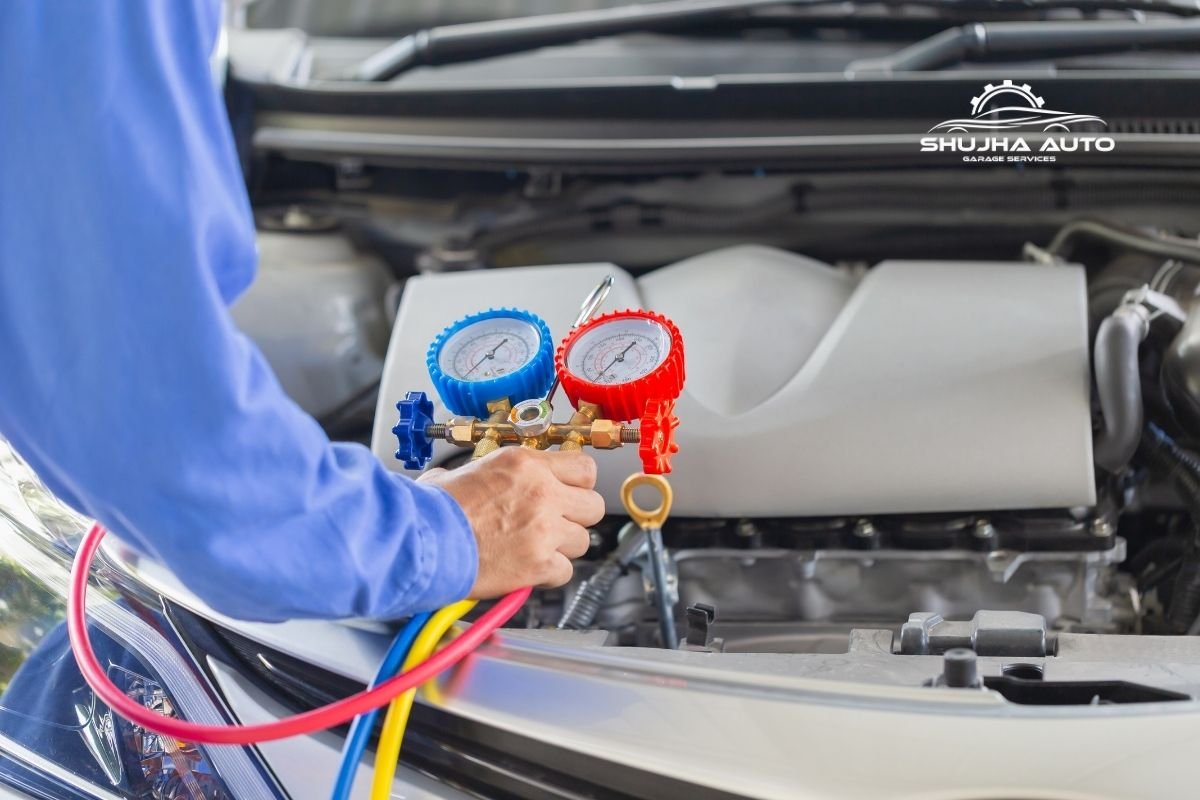
Auto Garage Services can help with AC service, AC inspection, cabin filter check, refrigerant check, and cooling performance diagnosis.
When Should You Check Transmission or Gearbox?
Transmission service timing depends on the vehicle type. Automatic transmission, manual gearbox, and CVT systems have different requirements. Transmission fluid usually does not need changing as often as engine oil, but it should still be checked regularly.
You should inspect your transmission if you notice:
- Delayed gear shifting
- Jerking while shifting
- Gear slipping
- Burning smell
- Transmission fluid leak
- Whining or humming noise
- Gearbox warning light
- Rough acceleration
Many vehicles need transmission fluid service somewhere between 40,000 and 80,000 kilometers, depending on manufacturer recommendation and driving conditions.
Auto Garage Services can help with transmission inspection, gearbox diagnostic service, and transmission fluid service.
When Should You Check Tyres?
Tyres should be checked more often than most drivers think. Tyre pressure should ideally be checked every 2 to 4 weeks. Tyre condition should be checked during every service.
You should check your tyres if you notice:
- Low tyre pressure
- Uneven tyre wear
- Cracks on sidewalls
- Bulges
- Vibration while driving
- Car pulling to one side
- Reduced road grip
- Low tread depth
Tyres affect braking, steering, fuel economy, and safety. In hot weather, weak tyres can become dangerous.
When Should You Check Battery?
Car batteries can become weak faster in hot climates. If your battery is more than two years old, it should be tested during service.
You should check your battery if you notice:
- Slow engine start
- Clicking sound when starting
- Dim headlights
- Battery warning light
- Electrical problems
- Frequent jump-starts
- Car struggles to start after parking
A weak battery can also affect sensors, ECU, and electronic modules. Testing the battery early can prevent sudden breakdowns.
When Should You Replace Car Filters?
Filters protect your engine and cabin. Dirty filters can reduce performance, fuel economy, AC airflow, and comfort.
Engine Air Filter
The engine air filter should be checked during every service. It should be replaced when dirty, especially if you drive in dusty areas.
A dirty engine air filter can cause weak acceleration, poor fuel economy, and rough engine performance.
Cabin Air Filter
The cabin air filter cleans the air entering the car interior. If it is dirty, AC airflow becomes weak and the cabin may smell bad.
Cabin filter replacement is commonly needed every 10,000 to 20,000 kilometers, depending on driving conditions.
Oil Filter
The oil filter should usually be replaced with every oil change. A dirty oil filter can reduce oil flow and affect engine protection.
Fuel Filter
Some vehicles have serviceable fuel filters. If the fuel filter is blocked, the car may feel weak, hesitate, or struggle to start.
Car Service Schedule by Mileage
Every car is different, but this general schedule helps drivers understand when common services are needed.
Every 5,000 to 10,000 Kilometers
This is usually the basic service range. It may include:
- Engine oil change
- Oil filter replacement
- Fluid level check
- Tyre pressure check
- Brake visual inspection
- Battery check
- Lights and wipers check
Every 10,000 to 20,000 Kilometers
This interval may include more detailed checks such as:
- Air filter replacement
- Cabin filter replacement
- Tyre rotation
- Brake inspection
- AC filter check
- Suspension check
- Diagnostic scan if needed
Every 40,000 to 60,000 Kilometers
At this stage, the car may need deeper inspection. This may include:
- Transmission fluid check
- Spark plug inspection
- Coolant condition check
- Brake fluid check
- Belt inspection
- Engine diagnostic check
- Full vehicle inspection
Every 80,000 to 100,000 Kilometers
Higher-mileage cars need careful inspection of major systems, including:
- Timing belt or chain condition
- Transmission health
- Suspension parts
- Engine mounts
- Cooling system
- Fuel system
- Major fluid services
- Full diagnostic scan
Always follow your car manual because service intervals can be different for each vehicle.
When Should You Service Your Car in UAE Conditions?
Driving conditions in the UAE can be harder on vehicles because of heat, dust, traffic, and frequent AC use. These conditions can reduce the life of engine oil, filters, tyres, batteries, and cooling system parts.
You may need earlier service if you drive in:
- Heavy city traffic
- Hot weather
- Dusty roads
- Industrial areas
- Long highway routes
- Short stop-and-go trips
- Frequent AC use
- Sandy parking areas
For many UAE drivers, servicing every 5,000 to 7,000 kilometers is a practical routine, especially for cars used daily in traffic or hot weather.
Warning Signs Your Car Needs Service Now
Sometimes your car needs service before the scheduled date. Warning signs should not be ignored.
Dashboard Warning Lights
If the check engine light, oil light, brake light, battery light, temperature warning, or transmission warning appears, get the car inspected quickly.
Unusual Noises
Grinding, knocking, squeaking, whining, rattling, or humming sounds can point to problems in the engine, brakes, suspension, tyres, or gearbox.
Poor Fuel Economy
If your car suddenly uses more fuel, it may need filter replacement, spark plug service, tyre pressure correction, engine diagnostic service, or sensor inspection.
Weak AC Cooling
Weak AC cooling may mean a dirty cabin filter, low refrigerant, compressor issue, cooling fan problem, or AC system fault.
Fluid Leaks
Oil, coolant, brake fluid, or transmission fluid leaks should never be ignored. Leaks can cause overheating, brake failure, engine damage, or gearbox problems.
Hard Starting
If the car takes longer to start, the battery, starter, fuel system, spark plugs, or engine sensors may need checking.
Vibration While Driving
Vibration can come from tyres, wheel alignment, suspension, brakes, engine mounts, or drivetrain parts.
What Happens During a Proper Car Service?
A proper car service should include more than a quick oil change. The technician should inspect important systems and explain any issues clearly.
At Auto Garage Services, car maintenance service may include:
- Engine oil and oil filter service
- Fluid level check
- Brake inspection
- Battery test
- Tyre pressure and condition check
- AC system check
- Filter inspection
- Belt and hose check
- Suspension inspection
- Leak inspection
- Diagnostic scan if required
- Road test if safe
- Clear repair guidance
This helps drivers understand their vehicle condition and plan repairs before problems become serious.
What Happens If You Delay Car Service?
Delaying service may seem like saving money, but it can create expensive repair problems later. Many major car issues start from small maintenance delays.
If you delay car service, you may face:
- Engine oil sludge
- Engine overheating
- Poor fuel economy
- Brake damage
- Battery failure
- Weak AC cooling
- Transmission problems
- Tyre wear
- Suspension damage
- Sudden breakdown
Regular servicing reduces these risks and keeps your car safer and more reliable.
Is Car Service Expensive?
Car service cost depends on the car model, oil type, parts needed, and whether it is basic or major service. A basic service usually costs less than repairing damage caused by neglect.
For example, oil change service is cheaper than engine repair. Brake pad replacement is cheaper than replacing damaged discs. Battery testing is cheaper than being stuck with a car that will not start.
The smart option is to service the car on time and fix small problems early.
Are There Any Hidden Fees or Charges?
A trusted garage should explain what is included in the service before starting work. You should know whether the service includes oil, filter, inspection, diagnostic scan, or additional checks.
If extra repair is needed, the issue and cost should be explained before proceeding. Auto Garage Services focuses on clear inspection and honest repair guidance, so customers can make informed decisions.
Free Diagnostic Check During Car Service
A diagnostic check can help find hidden issues before they become expensive repairs. This is especially useful if your car has warning lights, poor performance, unusual noise, or fuel consumption problems.
During service, Auto Garage Services can check important systems such as engine condition, battery, brakes, AC system, transmission, fluids, leaks, and dashboard warning codes.
This helps drivers service their cars with confidence instead of guessing what is wrong.
Why Choose Auto Garage Services?
Auto Garage Services provides car maintenance service, oil change service, brake inspection, engine diagnostic service, AC service, transmission inspection, battery check, and general vehicle inspection.
If your car is due for service or showing warning signs, the team can inspect it properly, explain the issue in simple words, and recommend the right service.
Drivers choose Auto Garage Services because of experienced technicians, proper diagnostic tools, clear repair guidance, practical repair advice, and customer-focused service.
When Should You Visit Auto Garage Services?
You should visit Auto Garage Services when your car reaches its service mileage, when 6 months have passed since the last service, or when you notice any warning signs.
You should also visit if your car has:
- Warning lights
- Unusual noise
- Poor fuel economy
- Weak AC cooling
- Hard starting
- Fluid leaks
- Brake problems
- Gear shifting issues
- Overheating
- Vibration while driving
Early service can protect your car, improve safety, and reduce repair costs.
FAQs
1. When should you service your car?
You should service your car every 5,000 to 10,000 kilometers or every 6 months, depending on the car model, oil type, driving conditions, and manufacturer recommendation. In hot, dusty, or heavy traffic conditions, earlier service may be better.
2. Should I service my car by mileage or time?
You should follow whichever comes first. If you reach the service mileage, service the car. If you drive less but 6 months have passed, service is still recommended because fluids, rubber parts, tyres, and batteries age over time.
3. What are the signs my car needs service?
Common signs include warning lights, unusual noises, poor fuel economy, weak AC cooling, fluid leaks, vibration, hard starting, overheating, rough performance, and gear shifting problems.
4. What is included in a basic car service?
A basic car service usually includes engine oil change, oil filter replacement, fluid level checks, tyre pressure check, brake visual inspection, battery check, lights check, and general safety inspection.
5. What is the difference between basic service and major service?
Basic service focuses on regular maintenance like oil and filter replacement. Major service is more detailed and may include spark plugs, filters, brake inspection, coolant check, transmission inspection, suspension check, diagnostic scan, and deeper vehicle checks.
6. Is car service necessary if I do not drive much?
Yes, car service is still necessary even if you drive less. Engine oil, battery, tyres, rubber parts, and fluids can age with time. Low-mileage cars should still be serviced based on time intervals.
7. How often should I change engine oil?
Engine oil is usually changed every 5,000 to 10,000 kilometers, depending on the oil type, car model, and driving conditions. Hot weather, traffic, dusty roads, and short trips may require earlier oil changes.
8. Can I delay service if my car feels fine?
It is not recommended to delay service only because the car feels fine. Many problems develop silently before warning signs appear. Regular service helps detect issues early and prevent expensive repairs.
9. Is car service more important in UAE weather?
Yes, hot weather, dust, traffic, and frequent AC use can put extra stress on your car. UAE driving conditions can affect oil, filters, tyres, batteries, AC systems, and cooling systems, so regular service is very important.
10. Does Auto Garage Services provide car maintenance service?
Yes, Auto Garage Services provides car maintenance service, oil change service, brake inspection, engine diagnostic service, AC service, transmission inspection, battery check, and related vehicle inspections.
Final Words
Knowing when to service your car helps protect your vehicle from breakdowns, poor performance, and expensive repairs. Most cars should be serviced every 5,000 to 10,000 kilometers or every 6 months, depending on the vehicle, oil type, and driving conditions.
In UAE conditions, heat, dust, traffic, and frequent AC use can make regular servicing even more important. You should also service your car earlier if you notice warning lights, unusual noises, weak AC, hard starting, fluid leaks, overheating, poor fuel economy, vibration, or gear shifting problems.
If your car is due for service or showing warning signs, visit Auto Garage Services for car maintenance service, oil change service, brake inspection, engine diagnostic service, AC service, transmission inspection, battery check, or general vehicle inspection.