
Brake pedal feels soft reason: Learn causes like air in brake lines, fluid leaks, worn pads, or master cylinder issues and how to fix them safely.
Have you ever pressed your brake pedal and felt it sink too far down? Maybe it felt mushy, like stepping on a wet sponge? Or worse—did it go all the way to the floor before your car finally stopped?
If you answered yes, you are not alone. This is one of the most common and scary problems a driver can face. A soft brake pedal means your car is not stopping as quickly as it should. That is dangerous for you, your family, and everyone else on the road.
I will explain every soft brake pedal cause in simple words. You will learn why this happens, how to fix it step by step, and when to call a professional like Shujha Auto Garage Services.
Let’s get straight into it.
Why a Firm Brake Pedal Matters
Before we talk about problems, let us understand how brakes should feel. In a healthy car, the brake pedal feels firm. When you press it, there is resistance. The car responds immediately.
A soft brake pedal means something is wrong. The pedal might feel:
- Spongy (like pushing a pillow)
- Low (it sinks near the floor)
- Gradual (it slowly drops while you are stopped at a red light)
Any of these signs means you need to act fast. Your brakes are your number one safety system.
The Most Common Soft Brake Pedal Causes
Let me list the main reasons your brake pedal feels soft. Understanding these soft brake pedal causes will help you fix the right problem.
1. Air in the Brake Lines
This is the number one reason. Brakes work using hydraulic pressure—basically, liquid pushing parts together. Air compresses easily. Liquid does not. When air gets into your brake lines, the pedal feels spongy.
2. Low Brake Fluid
Brake fluid is the lifeblood of your system. If the fluid level is low, there is not enough pressure. Your brake pedal goes to floor because nothing is pushing back against your foot.
3. Worn Brake Pads or Shoes
When brake pads get very thin, the caliper piston has to travel farther. This extra travel can make the pedal feel low or soft.
4. A Leak in the Brake System
Leaks can happen in brake lines, hoses, calipers, or the master cylinder. Even a tiny drip lets fluid escape. When fluid escapes, pressure drops. This is a very serious issue.
5. Bad Master Cylinder
The master cylinder is the part that pushes fluid to your brakes. If its internal seals fail, fluid leaks past them. You will often feel the pedal slowly sink to the floor while you are holding it down at a stoplight.
6. Overheated Brakes (Brake Fade)
If you drive down a long hill or use your brakes too hard, the fluid can boil. Boiling fluid creates gas bubbles. Those bubbles act just like air. This causes a spongy brake pedal reason that may go away after the brakes cool down.
7. Contaminated Brake Fluid
Brake fluid absorbs moisture from the air over time. Moisture lowers the boiling point and causes corrosion. Old, dirty fluid does not transfer pressure well.
8. Misadjusted Rear Brakes (Drum Brakes)
If your car has rear drum brakes, they need manual adjustment. If they are too loose, the pedal will feel low before the rear brakes engage.
Location: Please Visit Our Shujha Auto Garage
What Happens If You Ignore a Soft Brake Pedal?
Let me be very clear. Ignoring a soft brake pedal is never a good idea.
If an issue is found and you leave it alone, here is what can happen:
- Complete brake failure. One day you will press the pedal, and nothing will happen. The pedal will go straight to the floor.
- Longer stopping distances. You might rear-end the car in front of you.
- Damage to other parts. A small leak can ruin your master cylinder. Worn pads can destroy your rotors.
- Accidents and injuries. This is the worst outcome. Brakes are not something to gamble with.
So if your brake pedal goes to floor even once, stop driving. Tow the car to a garage. Your life is worth more than a tow truck fee.
Step-by-Step Fix Guide for a Soft Brake Pedal
Now, let me walk you through how to find and fix the problem. Some steps are easy for a home mechanic. Others need professional tools and experience.
Important safety warning: Do not attempt these repairs if you are not confident. Brakes are critical. A mistake can cause a crash. When in doubt, bring your car to Shujha Auto Garage Services.
Step 1: Check the Brake Fluid Level
This is the easiest and fastest check.
What you need: A clean rag and fresh brake fluid (check your owner’s manual for the correct type—DOT 3, DOT 4, or DOT 5.1).
How to do it:
- Park on level ground. Turn off the engine.
- Open the hood. Find the brake fluid reservoir. It is a small plastic tank near the back of the engine bay, usually on the driver’s side.
- Look at the side of the tank. There are MIN and MAX lines.
- If the fluid is below MIN, you have found a problem.
What it means:
- Low fluid often means a leak. Brake fluid does not burn off like oil. It must go somewhere.
- If the fluid is very dark or has floating bits, it is contaminated.
What to do next:
Add fluid to the MAX line. Then pump the brake pedal a few times. Does it feel better? If yes, the pedal may firm up temporarily. But you still need to find the leak.
Step 2: Inspect for Visible Leaks
What you need: A flashlight and a clean piece of cardboard.
How to do it:
- Place the cardboard under your car’s engine area. Leave it overnight.
- In the morning, check for wet spots. Brake fluid is clear to light brown and feels oily but thinner than motor oil.
- Use the flashlight to look at:
- Brake lines (metal tubes running under the car)
- Rubber brake hoses (near each wheel)
- Behind each wheel (caliper or wheel cylinder area)
- Under the master cylinder (look for fluid dripping down the firewall)
What it means:
Any wet spot is a leak. Even a slow seepage is dangerous.
What to do next:
Small leaks in metal lines can sometimes be repaired. Leaks in rubber hoses or calipers need part replacement. Do not drive with a known leak. Call a tow truck.
Step 3: Test the Master Cylinder
This test checks if the master cylinder is failing internally.
How to do it:
- With the engine off, press the brake pedal firmly.
- Hold the pressure steady. Do not move your foot.
- Does the pedal slowly sink toward the floor?
What it means:
If the pedal sinks slowly while you hold pressure, the master cylinder’s internal seals are leaking. Fluid is bypassing the seals instead of going to the brakes.
What to do next:
The master cylinder needs replacement. This is a medium-difficulty job. You also need to bleed all four brakes after replacing it. Most home mechanics should leave this to a pro.
Step 4: Bleed the Brakes (Remove Air)
If you have no leaks and the master cylinder is good, you likely have air in the lines. Bleeding removes that air.
What you need:
- Brake fluid (fresh, sealed bottle)
- A clear plastic tube
- A jar or bottle
- A wrench (usually 8mm or 10mm)
- A helper (or a one-man brake bleeder kit)
Step-by-step bleeding process:
- Safety first: Lift the car securely on jack stands. Remove all four wheels.
- Find the bleeding order: For most cars, start at the wheel farthest from the master cylinder (right rear), then left rear, then right front, then left front. Check your car’s manual.
- Clean the bleeder screw: Spray it with penetrating oil if it is rusty. Clean off dirt so nothing falls into the system.
- Attach the tube: Put one end of the clear tube over the bleeder screw. Put the other end into the jar. Fill the jar with about an inch of clean brake fluid. The tube must stay submerged.
- Have your helper pump: Your helper should pump the brake pedal three times and then hold it down firmly.
- Open the bleeder screw: While your helper holds the pedal down, open the bleeder screw about a half-turn. You will see fluid and bubbles flow through the tube. The pedal will sink to the floor.
- Close the screw: Tighten the bleeder screw. Then tell your helper to release the pedal.
- Repeat: Keep doing this until no more bubbles come out. Check the master cylinder fluid level every few cycles. Never let it run dry.
- Move to the next wheel: Repeat steps 4 through 8 for each wheel in the correct order.
What it means:
If you see many bubbles at first, then they stop, you have successfully removed the air. The pedal should feel much firmer.
What to do next:
Top off the brake fluid to the MAX line. Test drive slowly in a safe area. If the pedal still feels soft, there is another issue.
Step 5: Check the Brake Pads and Rotors
How to do it:
- With the wheel removed, look at the brake pads through the caliper.
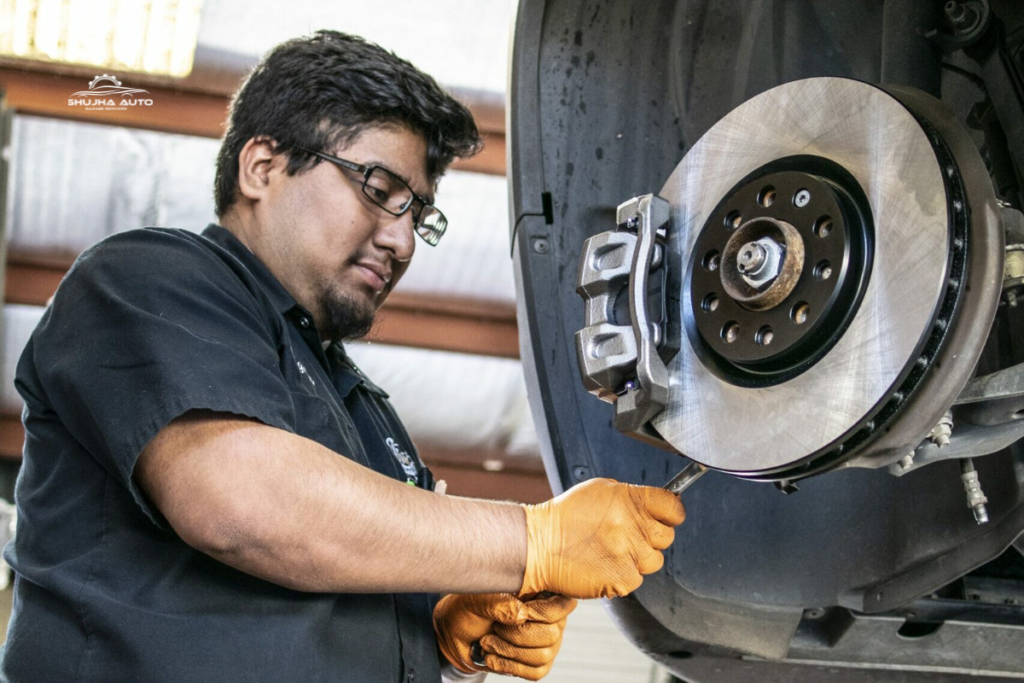
- A new pad has about 10-12mm of friction material. If it is less than 3mm, replace it.
- Look at the rotor surface. Deep grooves or a rusted lip mean the rotor should be replaced or resurfaced.
What it means:
Worn pads make the caliper piston extend too far. This extra travel makes the pedal feel low.
What to do next:
Replace pads in sets (both front or both rear). Replace or machine rotors as needed. After new pads, pump the pedal a few times to bring the pistons back into position.
Step 6: Check Rear Drum Brakes (If Applicable)
How to do it:
- Remove the rear drum.
- Look at the brake shoes. They should have at least 2-3mm of material left.
- Check the self-adjuster mechanism. It should move freely.
- Manually adjust the shoes outward until they just lightly drag on the drum when you spin it.
What it means:
Loose rear drums are a common spongy brake pedal reason. The pedal has to move too far before the shoes contact the drum.
What to do next:
Adjust the star wheel to tighten the shoes. If the adjuster is frozen, replace it. If the shoes are worn, replace them.
Step 7: Check for Brake Hose Bulges
How to do it:
- While a helper presses the brake pedal firmly, look at each rubber brake hose.
- Watch for any bulging or swelling.
What it means:
Old rubber hoses can weaken inside. They can swell like a balloon when you press the pedal. This absorbs pressure instead of sending it to the caliper.
What to do next:
Replace any bulging hose immediately. Always replace brake hoses in pairs (both fronts or both rears).
Step 8: Flush the Brake Fluid (If Contaminated)
How to do it:
Brake fluid should be clear or light amber. If it looks like dark coffee or has black specks, it is contaminated.
What to do next:
A full brake fluid flush is the solution. This is similar to bleeding, but you keep going until fresh, clean fluid comes out of every bleeder. A complete flush uses about one liter of fluid.
A Real Story from Shujha Auto Garage Services
Last month, a customer came to Shujha Auto Garage Services with a scary problem. Her brake pedal goes to floor almost every time she stopped at a traffic light. She had taken her car to two other garages. They told her nothing was wrong.
We did our free diagnostic check (more on that below). Within ten minutes, we found a tiny pinhole leak in a rear brake line. It was hidden behind a plastic cover. The leak was small, but over a week, it lost enough fluid to make the pedal dangerous.
We replaced the brake line, bled the system, and filled it with fresh fluid. The pedal was rock solid. She drove away safe and happy.
The lesson? Not all problems are obvious. You need a thorough inspection.
What If You Find a Problem? Here Is What Happens
Let me be honest with you. When you or a mechanic finds an issue with your brakes, you have two choices: fix it or ignore it.
If an issue is found and you choose to fix it properly, here is what happens next at a professional garage:
- You get a clear explanation. We tell you exactly what is wrong. No confusing words. No hidden surprises.
- You receive a written estimate. This includes parts, labor, and taxes. You approve the work before we turn a single wrench.
- We order quality parts. We use reliable brands that last. No cheap, unsafe knockoffs.
- The repair is done by trained technicians. Every bolt is tightened to the correct specification.
- We test your car. After any brake repair, we road-test the car to confirm the pedal is firm and the car stops straight.
- You get a warranty. All our brake repairs at Shujha Auto Garage Services come with a warranty on parts and labor.
If you choose to ignore a found issue, we will never force you to repair. But we will ask you to sign a safety waiver. This protects us and warns you of the risk.
Are There Any Hidden Fees or Charges?
This is a fair question. Many people worry about surprise costs when they visit a garage.
At Shujha Auto Garage Services, we believe in honesty and transparency. So let me answer directly:
Are there any hidden fees or charges?
No. Absolutely not.
Here is our promise:
- You approve all work before we start. We will never do an extra repair without calling you first.
- Our quoted price is the final price. Unless you ask us to do additional work, the price does not change.
- No “diagnostic fees” if you approve the repair. Some garages charge you to look at the car and then charge again to fix it. We do not do that.
- No disposal fees for old parts. That is built into our pricing. You never see a surprise line item.
- We show you the old parts. When we replace your brake pads, master cylinder, or any other part, we keep the old part ready for you to see. You can even take it home.
The only time a price changes is if we open the system and discover a new problem we could not see before. For example, we might quote you for a master cylinder replacement. But when we remove the old one, we see rust inside the brake lines. We will stop work, call you, explain the new issue, and give you a new price. You can say yes or no. No pressure. No hidden fee.
That is how honest business works.
What’s Included in the Free Diagnostic Check
You read that right. Shujha Auto Garage Services offers a free diagnostic check for soft brake pedals. We do not charge you just to look.
Here is exactly what’s included in the free diagnostic check:
- Brake fluid level and condition test. We check how much fluid you have and whether it is dirty or contaminated.
- Full visual inspection of all brake components. This includes:
- Master cylinder (checking for external and internal leaks)
- All brake lines (metal and rubber)
- All four calipers or wheel cylinders
- Brake pads and rotors (front)
- Brake shoes and drums (rear, if equipped)
- Parking brake mechanism
- Pedal feel test. We press and hold your brake pedal to feel for sinking, sponginess, or unusual travel.
- Test drive (if safe). We drive your car at low speed in a safe area to feel how the brakes perform under real conditions.
- Leak check using a UV dye (if needed). For very small, hard-to-find leaks, we can add a special dye to your brake fluid. Then we use a UV light to find the exact drip location. This is usually a paid service, but we include it for free during our diagnostic check.
- Written report. We give you a simple, easy-to-read report. It will say:
- What we found (even if everything is fine)
- What needs immediate repair
- What can wait (and for how long)
- An exact price to fix each item
- No-obligation estimate. You are never forced to repair with us. You can take our report anywhere. We want you to be safe, even if you go to another garage.
This free check takes about 20 to 30 minutes. It could save your life. Call us or walk in anytime.
When Should You Stop Driving Immediately?
Some soft brake pedal problems allow you to drive slowly to a garage. Others mean you should stop right now.
Stop driving immediately if:
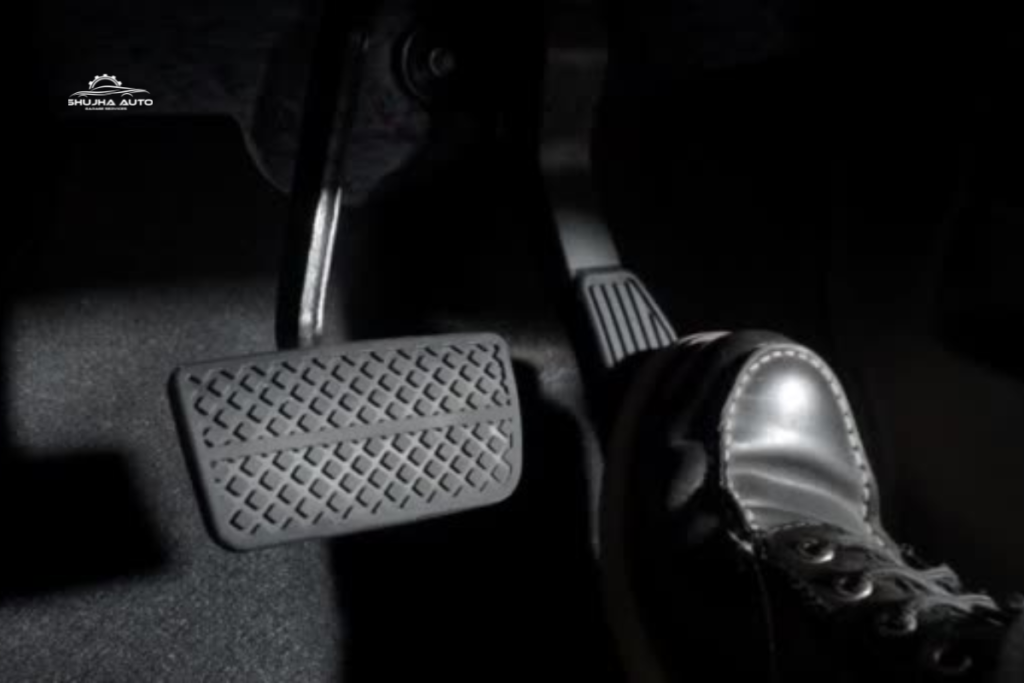
- Your brake pedal goes to floor with very little resistance.
- You see brake fluid dripping under your car.
- Your brake warning light is on.
- You hear a grinding noise when braking.
- The pedal feels fine one moment and then goes soft the next.
You can drive very slowly (under 30 mph) to a nearby garage if:
- The pedal feels spongy but still stops the car.
- You have no warning lights and no visible leaks.
- You can pump the pedal to build pressure.
When in doubt, call a tow truck. Shujha Auto Garage Services can recommend a reliable towing company. Your safety is not worth the risk.
Preventing a Soft Brake Pedal in the Future
Once you fix your brake problem, you want to avoid it happening again. Here is a simple prevention plan.
Every Month:
- Look at the brake fluid level. Top up if needed.
- Press the brake pedal in your driveway. Does it feel the same as last week?
Every 6 Months or 5,000 Miles:
- Have a professional look at your brakes. The free diagnostic check at Shujha Auto Garage Services is perfect for this.
Every 2 Years or 30,000 Miles:
- Flush and replace your brake fluid. Old fluid absorbs moisture and causes internal rust.
Every Brake Pad Change:
- Replace or machine rotors.
- Replace brake fluid.
- Inspect all rubber hoses.
Every 5 Years:
- Replace all rubber brake hoses as a set. Rubber degrades over time, even if the car is not driven much.
Why Choose Shujha Auto Garage Services for Your Brake Repair?
You have many choices for car repair. Let me tell you why drivers trust us.
- We speak simple language. We never use complicated words to confuse you. We explain brake problems like we are talking to a family member.
- We are certified and experienced. Our technicians have years of training on all makes and models—Japanese, Korean, American, and European.
- We use high-quality parts. No cheap, unsafe parts. Your brakes are too important for that.
- We stand behind our work. Every brake repair comes with a written warranty. If something we fixed fails, we fix it again at no charge.
- We respect your time. Most brake diagnostics take 30 minutes. Most repairs take 2 to 4 hours. We work efficiently without rushing.
- We clean up after ourselves. No grease on your seats. No tools left in your engine bay. We treat your car like our own.
- We offer fair prices. You are not paying for a fancy waiting room or expensive coffee machines. You are paying for honest, skilled work.
- We are local and independent.Shujha Auto Garage Services is part of your community. We know the local roads, the local weather, and how they affect your car.
Frequently Asked Questions About Soft Brake Pedals
Q: Can I just add more brake fluid to fix the problem?
A: Adding fluid helps if the level is low. But low fluid always means a leak or worn pads. You still need to find the root cause.
Q: How much does it cost to fix a soft brake pedal?
A: It depends on the cause. A simple brake bleed costs less than a full master cylinder replacement. We give free estimates so you know the price before any work starts.
Q: Is it safe to drive with spongy brakes?
A: It is not safe. Spongy brakes mean longer stopping distances. You might not stop in time in an emergency.
Q: How long does a brake bleed take?
A: About one hour for a professional. Home mechanics might take two to three hours.
Q: Can air get into the brake system by itself?
A: No. Air enters through leaks, low fluid, or during repairs. If you suddenly have air in your brakes, you have a leak somewhere.
Q: Why does my brake pedal go to floor only when the engine is running?
A: This is often a bad master cylinder. The engine provides power brake assist, which can mask the problem until you press harder.
Q: Do electric cars have soft brake pedal problems?
A: Yes. Electric cars still use hydraulic brakes for emergency stopping. They can have all the same problems as gas cars.
Your Next Step: Get That Brake Pedal Fixed Today
You have read the causes. You have seen the step-by-step fixes. You know what to look for.
Now it is time to take action.
Do not wait until your brake pedal goes to floor at a busy intersection. Do not hope the spongy feeling will go away on its own. It will not. It only gets worse.
Here is what you need to do:
- Check your brake pedal right now. Go to your car. Press the pedal with the engine off. Does it feel firm? Start the engine. Press again. Does it sink?
- If it feels wrong, do not drive far. Drive slowly to Shujha Auto Garage Services or call a tow truck.
- Ask for our free diagnostic check. Remember exactly what’s included in the free diagnostic check—full inspection, fluid test, pedal feel test, written report, and no-obligation estimate.
- Get a clear price and timeline. We tell you exactly what needs fixing and how much it costs. No games. No hidden fees. Remember our answer to are there any hidden fees or charges? The answer is no.
- Drive away safe. After we fix your brakes, you will feel the difference. A firm pedal. Instant stopping. Peace of mind.
Final Words from Shujha Auto Garage Services
Your car’s brakes are the most important safety system. They protect you, your passengers, and everyone sharing the road.
A soft brake pedal is not a minor annoyance. It is a warning. Listen to it.
We also told you exactly what happens if an issue is found, how we never charge hidden fees, and what’s included in our free diagnostic check.
Now the rest is up to you.
Visit Shujha Auto Garage Services today. Walk in, call us, or book online. Let us check your brakes for free. No pressure. No charge. Just honest help.
Because a safe car is a happy car. And we want you to be safe.
Shujha Auto Garage Services – Your Trusted Brake Experts
Open Monday to Saturday, 8 AM to 6 PM. Free parking. Free coffee while you wait.