



Car engine parts: learn key components, functions, and maintenance tips to keep your vehicle running smoothly and efficiently.
If you’re like most new drivers, popping open the hood of a car can feel like staring at a metal jungle. There are wires, hoses, metal blocks, and plastic covers everywhere. You might think, I’ll never understand any of this.
But here’s the good news: you don’t need to be a mechanic to understand the basics. Every car engine works on the same simple principles. Once you learn a handful of basic car engine parts, the whole picture starts to make sense.
At Shujha Auto Garage Services, we believe that knowledge saves you money. When you understand what’s inside your car, you can spot small problems before they become big, expensive nightmares. You can also talk to mechanics with confidence.
Will walk you through every major car engine components group. We’ll use plain English, real-world examples, and zero confusing jargon. By the end, you’ll be able to point to parts of your engine and explain what they do.
Let’s pop that hood—metaphorically first—and get started.
The Big Picture – How an Engine Works in Simple Terms
Before we dive into individual engine mechanical parts, let’s understand what the engine actually does.
Think of your car’s engine as a large air pump. It sucks in air and fuel, squeezes them, ignites the mixture, and pushes out exhaust. That series of events—suck, squeeze, bang, blow—happens thousands of times per minute.
This is called the four-stroke cycle:
- Intake stroke – The piston moves down, sucking air and fuel into the cylinder.
- Compression stroke – The piston moves up, squeezing the mixture tight.
- Power stroke – A spark plug fires, exploding the mixture and pushing the piston down with force.
- Exhaust stroke – The piston moves up again, pushing burnt gases out through the exhaust.
All basic car engine parts work together to make this cycle happen smoothly. If one part fails, the cycle breaks, and your car runs poorly or not at all.
Now, let’s meet the key players.
The Engine Block – The Heart’s Home
The engine block is the largest single piece of metal in your car. It’s usually made of cast iron or aluminum. Think of it as the skeleton or the foundation of the entire engine.
Inside the block, you’ll find cylindrical holes called cylinders. Most cars have four, six, or eight cylinders arranged in a line, a V-shape, or a flat pattern.
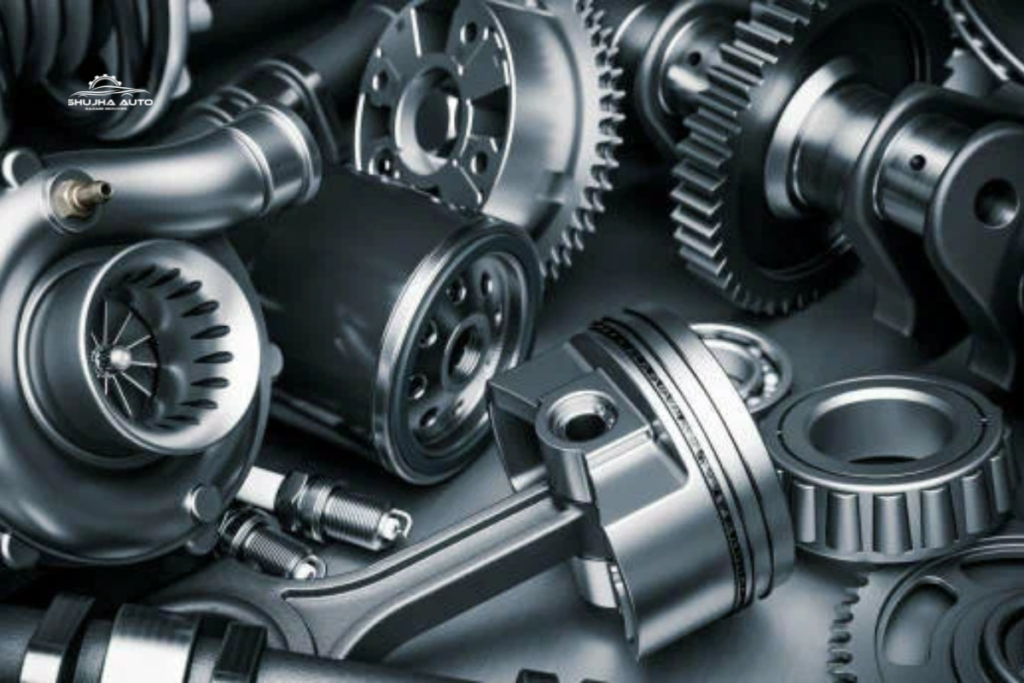
The engine block houses several engine mechanical parts:
- Cylinders (where the pistons move up and down)
- Oil passages (to keep everything slippery)
- Coolant passages (to keep everything cool)
- The crankshaft (we’ll get to that)
If the engine block cracks, it’s usually a very serious problem. Coolant can leak into the oil, or oil can leak out. At Shujha Auto Garage Services, we see cracked blocks mostly from overheating. That’s why watching your temperature gauge is so important.
Beginner tip: Look for the largest metal chunk under the hood. That’s your engine block. Everything else is bolted to it.
Pistons and Connecting Rods – The Movers
Inside each cylinder lives a piston. A piston is a cylindrical metal plug that fits snugly inside the cylinder. It moves up and down thousands of times per minute.
Attached to each piston is a connecting rod. The rod connects the piston to the crankshaft. So when the piston moves up and down, the rod pushes and pulls the crankshaft.
Pistons have rings around them. These rings seal the gap between the piston and the cylinder wall. They prevent fuel and exhaust from leaking past. If piston rings wear out, your car will burn oil and blow blue smoke from the tailpipe.
Real-world example: Have you ever seen an old car leaving a cloud of blue smoke? That’s usually worn piston rings or valve seals. Not a cheap fix, but catching it early helps.
Among all car engine components, pistons and rings are some of the hardest working. They experience extreme heat (up to 2,500°F during combustion) and extreme pressure. When they fail, you’ll notice loss of power, rough running, or smoke.
Crankshaft – Turning Up and Down into Round and Round
The crankshaft is a long, heavy metal shaft at the bottom of the engine block. It has offset lobes (called journals or throws) that the connecting rods attach to.
When the pistons push down, the connecting rods force the crankshaft to rotate. That rotation is what eventually turns your car’s wheels.
Think of it like pedaling a bicycle. Your legs go up and down (like pistons), but the pedal crank turns in a circle (like a crankshaft). Same idea.
The crankshaft also has a large heavy wheel at one end called the flywheel (or flexplate in automatic cars). The flywheel smooths out the engine’s pulses and helps it idle smoothly.
Beginner warning: If your engine makes a deep knocking noise that gets faster when you accelerate, you might have a bad crankshaft bearing. Don’t ignore this. Bring it to Shujha Auto Garage Services immediately.
Cylinder Head – The Brain’s Office
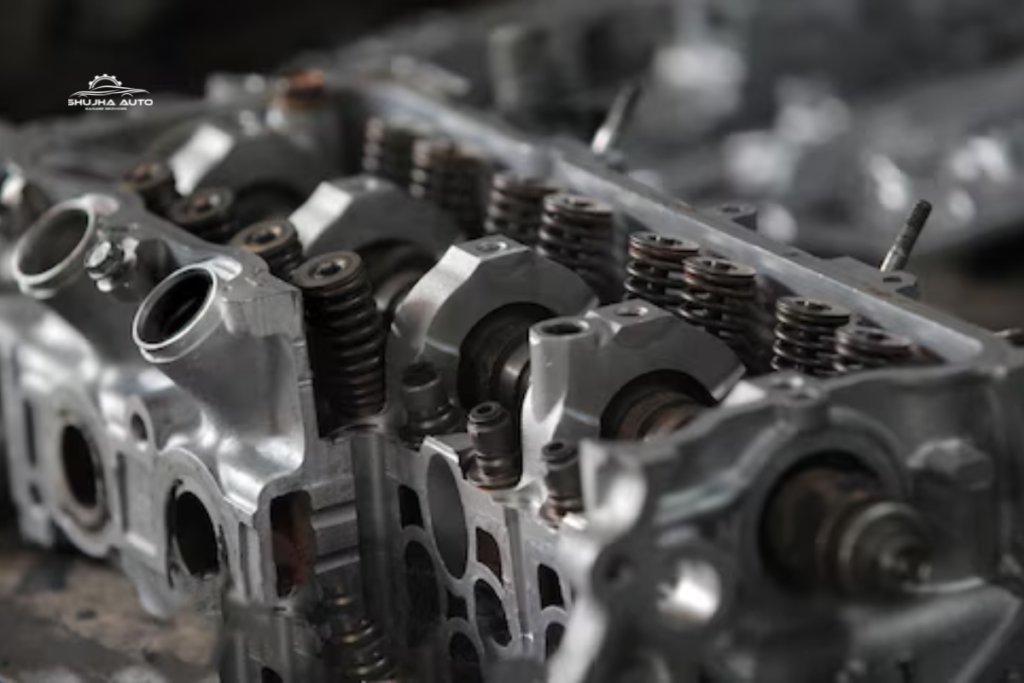
The cylinder head bolts onto the top of the engine block. It seals the cylinders from above, creating the combustion chamber.
The head contains several critical basic car engine parts:
- Valves (intake and exhaust)
- Spark plugs
- Fuel injectors (in most modern cars)
- Camshaft (in overhead cam engines)
- Passages for coolant and oil
If the block is the body, the cylinder head is the command center. It controls when air/fuel enters, when the spark happens, and when exhaust leaves.
A common problem is a warped cylinder head. This happens when the engine overheats badly. The metal bends slightly, and the head no longer seals perfectly. Then coolant leaks into the cylinders or exhaust gases get into the coolant.
Symptoms include white smoke from the exhaust, loss of coolant with no visible leak, and rough running.
Location: Please Visit Our Shujha Auto Garage
Valves and Camshaft – The Door Keepers
Valves are like tiny doors. Each cylinder has at least two valves: one intake valve (lets air/fuel in) and one exhaust valve (lets burnt gases out). Many modern engines have four valves per cylinder (two intake, two exhaust) for better breathing.
The camshaft is a metal rod with egg-shaped lobes (called “cams”). As the camshaft spins, the lobes push the valves open at exactly the right time. Springs then close the valves.
In older engines, the camshaft is in the engine block (cam-in-block or “pushrod” design). In most modern cars, the camshaft is in the cylinder head (overhead cam or OHC). Some engines have two camshafts per head (dual overhead cam or DOHC).
Timing is everything. The camshaft must spin at exactly half the speed of the crankshaft. That’s why a timing belt or timing chain connects them. If that belt breaks, the pistons can crash into the valves. That’s catastrophic engine damage.
This is one of those engine mechanical parts that you absolutely must maintain. Check your owner’s manual for timing belt replacement intervals (usually every 60,000 to 100,000 miles).
Spark Plugs and Ignition System – The Fire Starters
Without a spark, the air/fuel mixture won’t burn. Spark plugs create that spark. Each cylinder has one spark plug (some performance engines have two).
The spark plug screws into the cylinder head, with its tip inside the combustion chamber. At exactly the right moment (just before the piston reaches the top of the compression stroke), the ignition system sends a high-voltage pulse (20,000–40,000 volts) to the plug. A spark jumps the gap at the tip, igniting the fuel.
Worn spark plugs cause:
- Hard starting
- Rough idle
- Poor fuel economy
- Misfires (that jerking feeling when accelerating)
Most spark plugs last 30,000 to 100,000 miles, depending on the type (copper, platinum, or iridium). Replacing them is cheap insurance.
The rest of the ignition system includes:
- Ignition coils (step up 12V battery power to high voltage)
- Spark plug wires (carry the spark to the plugs in older cars)
- Crankshaft position sensor (tells the computer when to fire)
Modern cars have coil-on-plug systems, where a small coil sits directly on each spark plug. No wires needed.
Fuel System – The Feeding Tubes
Your engine needs fuel to burn. The fuel system delivers that fuel in the right amount, at the right pressure, at the right time.
Basic car engine parts in the fuel system:
- Fuel tank (holds the gas)
- Fuel pump (sends fuel forward, usually electric and inside the tank)
- Fuel filter (traps dirt and rust)
- Fuel lines (metal tubes or hoses)
- Fuel injectors (computer-controlled spray nozzles)
- Fuel pressure regulator (keeps pressure steady)
In older cars, a carburetor mixed air and fuel mechanically. But anything built after about 1990 uses fuel injection. Fuel injection is more precise, efficient, and reliable.
Fuel injectors spray a fine mist of fuel into the intake port (or directly into the cylinder in “direct injection” engines). The computer opens each injector for a few milliseconds at a time.
Symptoms of fuel system problems:
- Difficulty starting
- Stalling
- Hesitation when accelerating
- Poor fuel economy
One common issue is clogged injectors. A professional cleaning at Shujha Auto Garage Services often restores lost power and smoothness.
Air Intake System – The Lungs
An engine without air is like a person holding their breath. It simply won’t work. The air intake system brings clean, filtered air into the engine.
Main components:
- Air filter (traps dirt, dust, leaves)
- Air intake tube (connects filter to throttle body)
- Throttle body (contains a butterfly valve that opens when you press the gas pedal)
- Intake manifold (distributes air to each cylinder)
When you press the gas pedal, you’re actually opening the throttle plate wider. More air flows in. Sensors detect that air, and the computer adds more fuel. The engine speeds up.
A dirty air filter restricts airflow, reducing power and fuel economy. Checking and replacing the air filter is one of the easiest and cheapest maintenance tasks. Most filters cost under $20, and you can see through it to know if it’s dirty.
Some cars also have a mass airflow sensor (MAF) or manifold absolute pressure sensor (MAP) to measure how much air is entering. If these sensors fail, the computer gets confused, and the engine runs poorly.
Exhaust System – Getting Rid of Waste
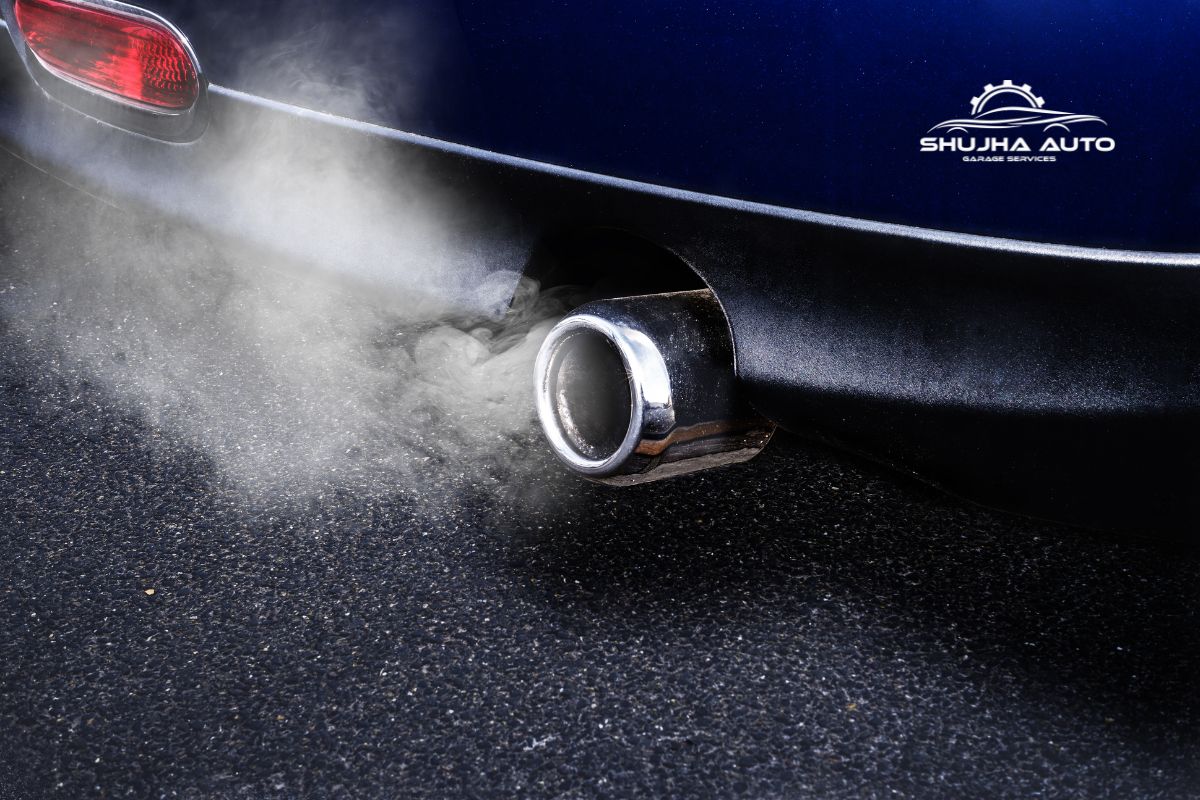
After combustion, leftover gases must leave. That’s the exhaust system’s job. It also reduces noise and cleans up harmful emissions.
Path of exhaust gases:
- Exhaust valve opens
- Gases flow into exhaust manifold (bolted to cylinder head)
- They pass through oxygen sensors (measure unburned oxygen)
- They enter the catalytic converter (turns harmful CO, NOx, and HC into CO2, water, and nitrogen)
- They pass through a muffler (reduces noise)
- They exit through the tailpipe
A damaged exhaust system can cause:
- Loud noises (roaring, hissing, or popping)
- Poor fuel economy
- Failed emissions tests
- Exhaust fumes entering the cabin (dangerous!)
If you hear a sudden loud exhaust noise, you probably have a rusted-out pipe or blown gasket. Don’t delay fixing it. Carbon monoxide is odorless and deadly.
Among all car engine components, the exhaust system is often overlooked until it fails. Regular visual checks for rust and holes can save you from a roadside surprise.
Lubrication System – The Engine’s Blood
Your engine has many moving metal parts sliding against each other. Without oil, they would weld together in seconds. The lubrication system prevents that.
Key parts:
- Oil pan (holds the oil at the bottom of the engine)
- Oil pump (pulls oil from the pan and pushes it through the engine)
- Oil filter (removes dirt and metal particles)
- Oil passages (drilled holes in the block and head)
- Oil pressure sensor (warns you if pressure drops)
The oil pump sends pressurized oil to the crankshaft bearings, connecting rod bearings, camshaft bearings, and valve train. The oil then drips back down to the oil pan, and the cycle repeats.
Why oil changes matter: Over time, oil breaks down from heat and gets contaminated with combustion byproducts. Old, dirty oil doesn’t lubricate well. That leads to premature wear on engine mechanical parts.
Simple rule: Change your oil and filter every 5,000 to 7,500 miles for conventional oil, or as your owner’s manual says. Synthetic oil can go longer (up to 10,000–15,000 miles in some cars).
If your oil pressure light comes on, pull over immediately and turn off the engine. Driving with no oil pressure will destroy the engine in minutes.
Cooling System – Preventing Meltdowns
Combustion creates enormous heat. Without cooling, metal parts would expand, seize, or melt. The cooling system removes about one-third of the engine’s heat.
Main components:
- Coolant (a mix of antifreeze and water)
- Radiator (a large heat exchanger at the front of the car)
- Water pump (circulates coolant through the engine and radiator)
- Thermostat (regulates temperature by opening and closing)
- Cooling fans (pull air through the radiator when the car is stopped)
- Hoses (connect everything)
- Heater core (a small radiator inside your dashboard that provides cabin heat)
Here’s how it works: The water pump pushes coolant through passages in the engine block and cylinder head. The coolant absorbs heat, then travels to the radiator. The radiator releases that heat to the outside air. Cooled coolant returns to the engine.
The thermostat stays closed when the engine is cold, helping it warm up faster. Once the engine reaches operating temperature (usually around 195°F to 220°F), the thermostat opens.
Warning signs of cooling system trouble:
- Temperature gauge reading higher than normal
- Steam coming from under the hood
- Sweet smell (that’s coolant)
- Puddles of green, orange, or pink liquid under your car
- Heater blowing cold air (could mean low coolant)
Overheating is an engine killer. If your temperature gauge goes into the red, pull over safely and turn off the engine. Call a tow truck. Driving even one minute overheated can warp the cylinder head or crack the block.
At Shujha Auto Garage Services, we see far too many engine failures caused by neglected cooling systems. A simple thermostat or hose can prevent a engine replacement.
The Engine Control Unit (ECU) – The Brain
Modern engines have a small computer called the Engine Control Unit (ECU). It’s also called the PCM (Powertrain Control Module).
The ECU uses sensors to monitor everything:
- How much air is entering
- How much oxygen is in the exhaust
- Engine temperature
- Crankshaft position
- Camshaft position
- Throttle position
- Knock (detonation)
Based on that data, the ECU controls:
- How much fuel to inject
- When to fire the spark plugs (timing)
- Idle speed
- Variable valve timing (if equipped)
- Turbocharger boost (if equipped)
When something goes wrong, the ECU turns on the Check Engine light and stores a diagnostic trouble code (DTC). A mechanic can plug a scanner into the car’s OBD-II port (usually under the dashboard) and read those codes.
Important: The code tells you which system has a problem, not exactly which part failed. For example, a code P0302 means cylinder 2 misfire. The cause could be a bad spark plug, bad coil, bad injector, vacuum leak, or even low compression. Diagnosis requires skill and experience.
That’s where Shujha Auto Garage Services comes in. We don’t just read codes and throw parts at the problem. We diagnose the root cause.
Turbochargers and Superchargers (If Your Car Has Them)
Not every car has forced induction, but many modern cars do—especially small engines. A turbocharger or supercharger forces more air into the engine, allowing it to burn more fuel and make more power.
Turbocharger: Uses exhaust gases to spin a turbine. That turbine spins a compressor, which pushes air into the engine. It’s free power from waste exhaust energy, but there’s a slight delay called turbo lag.
Supercharger: Belt-driven directly from the crankshaft. Instant boost, no lag, but it uses some engine power to run.
Key parts in a turbo system:
- Turbocharger unit (turbine + compressor)
- Intercooler (cools the compressed air, making it denser)
- Wastegate (controls boost pressure)
- Blow-off valve (releases pressure when you lift off the throttle)
Turbo engines run hotter and have more stress on engine mechanical parts. That means you need:
- More frequent oil changes (turbo heat breaks down oil faster)
- High-quality synthetic oil
- A cool-down period after hard driving (let the engine idle a minute before shutting off)
If you have a turbocharged car, treat it well, and it will reward you with power and efficiency. Neglect it, and turbo failure can send metal shards into your engine.
Belts and Chains – The Connectors
Your engine has belts and chains that transfer motion to various components.
Timing belt or timing chain: Connects the crankshaft to the camshaft(s). This is critical. If it breaks, pistons hit valves. Engine destroyed. Timing chains last much longer than belts (often the life of the engine), but belts need replacement every 60,000–100,000 miles.
Serpentine belt (or drive belt): A single long belt that snakes around various pulleys. It drives the alternator, power steering pump, air conditioning compressor, and water pump (on many cars). If this belt breaks, you lose charging, power steering, and cooling. The car becomes hard to steer and will overheat.
Symptoms of a bad serpentine belt:
- Squealing noise when starting or turning
- Cracks or fraying visible on the belt
- Battery warning light (alternator not spinning)
Belts are cheap. Engine damage from a broken belt is not. Inspect your belts regularly. Replace them if you see cracks, glazing (shiny spots), or fraying.
Common Engine Problems and What They Sound Like
Your engine talks to you. It makes different sounds for different problems. Learning these sounds can save you thousands.
| Sound | Likely Problem |
| Clicking or tapping that speeds up with RPM | Low oil, worn lifters, or valve train issue |
| Deep knocking (like someone hitting the block with a hammer) | Worn connecting rod or main bearing |
| Squealing on startup or acceleration | Loose or worn serpentine belt |
| Hissing under hood | Vacuum leak or cooling system leak |
| Loud roaring that changes with speed | Exhaust leak |
| Metallic rattling at idle | Loose heat shield or timing chain tensioner |
| Popping through intake | Lean condition or valve problem |
| Backfiring through exhaust | Rich condition or ignition timing off |
If you hear any of these, don’t panic. But don’t ignore them either. Small problems become big problems fast. Bring your car to Shujha Auto Garage Services for a proper diagnosis.
The Free Diagnostic Check – What’s Included
At Shujha Auto Garage Services, we believe in transparency. That’s why we offer a free diagnostic check for certain basic issues. We want you to understand what’s happening with your car before you spend any money.
What’s included in the free diagnostic check?
- Visual inspection of all major basic car engine parts (belts, hoses, fluids, leaks)
- Check engine light code reading (we plug in our scanner and tell you the codes)
- Basic battery and charging system test
- Coolant level and condition check
- Oil level and condition check
- Air filter inspection
- Brief road test (if needed) to confirm symptoms
This free check is not a full tear-down. It’s a professional’s first look. We’ll tell you what we find, explain it in plain English, and give you an honest recommendation.
If we find a serious issue, we’ll explain exactly what failed, why it failed, and what your options are. No pressure. No upselling. Just honest advice.
What Happens If an Issue Is Found?
This is the most common question we hear. You bring your car in for a noise or a light. We find something. Now what?
What happens if an issue is found? Here’s our step-by-step process:
- We explain the problem clearly. We’ll show you the failed part if possible. We’ll tell you why it matters and what will happen if you delay repairs.
- We give you a written estimate. Every repair we recommend comes with a detailed estimate showing parts, labor, and tax. No surprises.
- We explain urgency. Some problems are “fix now” (like a leaking radiator or failed water pump). Others are “monitor and plan” (like a small valve cover leak). We’ll be honest about what can wait and what can’t.
- We answer your questions. You can ask anything. “Can I drive it home?” “Will this part fail completely?” “Is there a cheaper option?” We’ve heard every question. We’ll answer truthfully.
- We only fix what you approve. We never start work without your permission. If we find additional problems during a repair, we stop and call you first.
- We guarantee our work. All repairs at Shujha Auto Garage Services come with a warranty. If the same part fails again due to our workmanship, we fix it free.
If the issue is minor—say, a loose gas cap causing a check engine light—we might even fix it on the spot at no charge. That’s just how we do business.
Are There Any Hidden Fees or Charges?
Let’s address this head-on because nobody likes surprise charges.
Are there any hidden fees or charges? At Shujha Auto Garage Services, the answer is no. Absolutely not. Zero. Zilch.
Here’s what you can expect:
- The free diagnostic check is truly free. No fine print. No free with repair. No diagnostic fee waived if you approve work. It’s free, period.
- Our estimates are complete. We include parts, labor, shop supplies (like grease, rags, and cleaner), and tax. Some shops add a shop supplies fee later. We include it upfront.
- We don’t charge disposal fees for old parts. Many shops add for recycling oil, batteries, or tires. We build that into our standard pricing. You never see a surprise line item.
- We don’t charge for computer reprogramming as an extra. If a repair requires software updates or programming, it’s included in the labor estimate.
- We don’t invent extra work. You won’t hear Your blinker fluid is low or Your muffler bearings are worn. We fix what’s broken. Nothing more.
If you ever receive an invoice from us with a fee you don’t understand, ask us. We’ll explain every line. And if we made a mistake, we’ll fix it.
We want you to be a customer for life, not for one expensive visit. That means honesty and transparency in every transaction.
Maintenance Schedule That Saves You Money
Knowing car engine components is one thing. Keeping them healthy is another. Here’s a simple maintenance schedule for most cars.
Every 3,000–5,000 miles (or as your manual says):
- Change engine oil and filter
- Check all fluids (coolant, brake, power steering, transmission, washer)
Every 5,000–7,500 miles:
- Rotate tires
- Inspect belts and hoses
Every 15,000 miles:
- Replace engine air filter
- Replace cabin air filter
- Inspect spark plugs
Every 30,000 miles:
- Replace spark plugs (if copper or platinum)
- Replace fuel filter (if external)
- Inspect timing belt
Every 60,000 miles:
- Replace timing belt (if equipped)
- Replace water pump (smart to do with timing belt)
- Replace serpentine belt
- Flush and replace coolant
- Replace automatic transmission fluid (check your manual)
Every 100,000 miles:
- Replace spark plugs (if iridium)
- Replace oxygen sensors (preventive)
- Inspect catalytic converter
This schedule varies by car. Your owner’s manual is the final authority. But following something close to this will keep most engine mechanical parts happy for 200,000 miles or more.
When to Repair vs. Replace the Whole Engine
Sometimes an engine gets sick beyond reasonable repair. How do you know when to fix individual parts versus swapping the whole engine?
Repair individual parts when:
- The problem is one component (e.g., a failed water pump, bad alternator, leaking valve cover)
- The engine has under 150,000 miles
- The rest of the car is in good shape
- The repair cost is under 50% of the car’s value
Replace the whole engine (or sell the car) when:
- The engine has a cracked block or head
- The crankshaft bearings have failed (deep knock)
- The engine has been run without oil or coolant
- Compression is low on multiple cylinders
- The repair estimate exceeds the car’s value
At Shujha Auto Garage Services, we’ll give you an honest recommendation. We won’t push you into an expensive repair that doesn’t make financial sense.
Why Choose Shujha Auto Garage Services?
We’ve talked a lot about engines. Now let’s talk about us—humbly.
Shujha Auto Garage Services was built on one idea: car repair should be honest, affordable, and understandable. Too many shops hide behind jargon and surprise bills. We do the opposite.
What makes us different:
- We teach as we work. Every time you bring your car in, we explain what we found, why it matters, and how to prevent it next time. You leave smarter than when you arrived.
- We use high-quality parts. No cheap no-name parts that fail in six months. We use OEM or premium aftermarket parts with real warranties.
- We stand behind our work. Our repairs are guaranteed. If something we fixed fails due to our error, we make it right—no arguments.
- We respect your time. We give honest time estimates and call you if anything changes. No “it’ll be ready Tuesday” then silence until Friday.
- We’re fairly priced. We’re not the cheapest. Cheap work is expensive in the long run. But we’re also not luxury-priced. You get professional work for a fair price.
- We specialize in diagnostics. Many shops guess and replace parts until the problem goes away. We diagnose first. That saves you money and frustration.
Whether you drive a 2024 luxury sedan or a 2005 commuter car, you’ll get the same honest treatment at Shujha Auto Garage Services.
Conclusion: You Know More Than You Think
You just read nearly 6,000 words about car engine components. That’s more than most drivers learn in a lifetime.
Let’s recap the most important points:
- Every engine needs air, fuel, spark, and compression to run.
- The main basic car engine parts are the block, pistons, crankshaft, cylinder head, valves, camshaft, spark plugs, fuel injectors, oil pump, and water pump.
- Engine mechanical parts wear out over time. Regular maintenance is cheaper than major repairs.
- Listen to your engine. Unusual sounds are your car asking for help.
- When a problem is found, get a clear explanation and written estimate before approving work.
- Choose a garage that values honesty over profit.
You are now equipped to pop your hood with confidence. You can check your oil, spot a leaking hose, understand a check engine light, and talk to mechanics as a partner—not a victim.
And when you need professional help—whether it’s a strange noise, a warning light, or just a routine oil change—Shujha Auto Garage Services is here for you.
We’re not the biggest garage. But we aim to be the most trusted.
Visit us for your next service. Bring this blog post with you. We’ll be happy to walk you through every part we inspect.
Your engine has a lot of life to give. Let’s make sure it lives every mile.
Drive safe. Drive smart. And keep learning about your car.— The Team at Shujha Auto Garage Services