



Electric car battery life affects performance, range, and cost. Learn how long batteries last, key factors, and tips to extend electric car battery life.
By Shujha Auto Garage Services
So, you’ve finally made the switch to an electric vehicle. Congratulations!
Whether you’ve just unboxed a brand-new Tesla, Hyundai Ioniq, Nissan Leaf, or MG ZS EV, you are now part of a revolution. Driving electric is smooth, quiet, and incredibly cheap to run.
But now that the new car smell is settling in, a question is probably creeping into your mind:
How long is this battery actually going to last?
It’s the number one concern we hear from new customers walking into Shujha Auto Garage Services. You aren’t worried about the engine—because there isn’t one. You aren’t worried about the gearbox—because you don’t need one. You are worried about the giant, expensive battery pack sitting under your feet.
Don’t worry. We’ve got you covered.
We are going to explain everything you need to know about EV battery life expectancy. We’ll use simple words, no confusing engineering jargon, and we’ll tell you exactly how to keep your car running for hundreds of thousands of miles. Plus, we’ll answer the tough questions about costs, warranties, and what happens if something goes wrong.
Let’s dive in.
The Truth About EV Battery Life Expectancy
Let’s start with the big question: How long does an EV battery actually last?
If you search online, you might see scary headlines about batteries dying after 100,000 miles. That information is old. It’s based on very early cell phone technology and the first-generation Nissan Leafs from 2011.
The reality in 2025 is much better.
Most modern electric car batteries are designed to last as long as the car itself. We aren’t just saying that to make you feel better. Data from thousands of Tesla, BMW, and Kia EVs show that batteries lose capacity very slowly.
On average, an EV battery loses about 1% to 2% of its range per year.
Let’s put that in perspective:
- If you buy a car with 300 miles of range today.
- After 5 years, you will likely have roughly 280–290 miles of range.
- After 10 years, you will likely have roughly 260–270 miles of range.
You don’t lose range in big chunks. You lose it so slowly that most drivers don’t even notice.
The true EV battery life expectancy today is 150,000 to 200,000 miles, and often much longer. Some Tesla Model S vehicles with original batteries have passed 300,000 miles and are still driving around just fine.
So, take a deep breath. Your battery is not a ticking time bomb. It is a durable, engineered component that is built to last.
Location: Please Visit Our Shujha Auto Garage
Understanding EV Battery Degradation (The Laptop Analogy)
To understand EV battery degradation, think about your smartphone or laptop.
Remember when you bought your phone two years ago? It lasted all day. Now, maybe you need to charge it by 4:00 PM. The phone didn’t break—it just lost a little bit of its maximum capacity. It still works, just with less stamina.
Your EV works the same way.
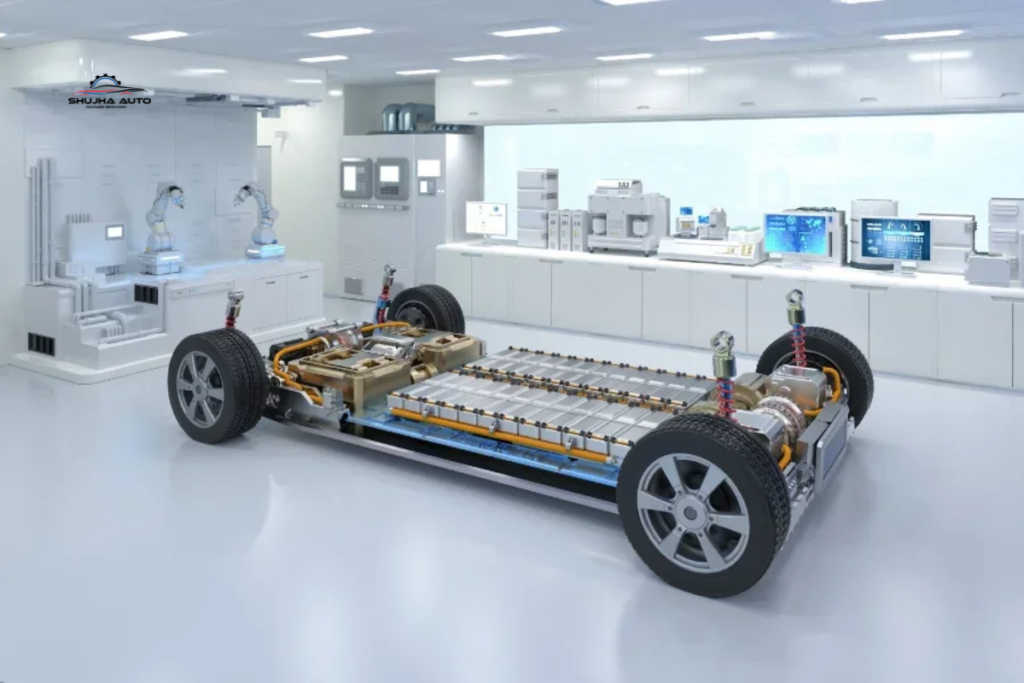
Inside your car is a lithium-ion battery pack. Every time you charge and discharge it, the chemistry inside ages just slightly. You can’t stop it completely, but you can absolutely slow it down.
What causes faster degradation?
- Extreme Heat: Constant hot weather is harder on batteries than cold weather.
- Frequent Fast Charging: Using DC rapid chargers (the big ones at highway stations) every single day creates more heat.
- Full Charges: Charging to 100% every night and leaving it there for hours.
- Deep Discharges: Running the battery down to nearly 0% often.
The Good News:
Modern EVs have sophisticated thermal management systems (basically, fancy liquid cooling) that protect the battery. Unless you are driving a very old electric car, the battery management computer is constantly working to keep your cells happy.
How to Maximize Electric Car Battery Longevity
At Shujha Auto Garage Services, we want you to get the absolute most out of your investment. You don’t need to obsess over the battery, but following these five simple habits will dramatically improve your electric car battery longevity.
- Keep It Between 20% and 80% (For Daily Driving)
This is the golden rule.
Unless you are going on a long road trip, try not to charge to 100% every night, and try not to let it drop below 10%. Lithium-ion batteries are happiest when they are in the middle. Think of it like a goldilocks zone.
- Be Kind to Fast Chargers
We know fast chargers are convenient. We use them too! But if you have a home charger, use it 90% of the time. Save the 350kW super-fast charging for when you actually need it on a long journey. Your battery will thank you.
- Don’t Let It Sit at 100% (Or 0%)
If you charge to 100% because you have a trip at 10:00 AM, that’s fine. But if you charge to 100% on Friday night and don’t drive until Monday morning, the battery is sitting at a high-stress voltage level. Most modern cars let you set a charge limit to 80%. Use that feature.
- Mind the Heat
If you live in a very hot climate (like the UAE or Arizona), parking in the shade or a garage makes a big difference. Heat is the enemy of EV battery degradation.
- Don’t Worry Too Much
Honestly, just drive the car. These tips will help you maximize the lifespan, but don’t lose sleep over it. The technology is robust.
The Warranty – Your Safety Net
You might be thinking, Okay, I’ll try to look after it, but what if something happens?
This is the best part of owning an EV today.
By law in most countries, and by standard industry practice, EV batteries come with a long warranty.
Typically, this is:
- 8 years or 100,000 miles (whichever comes first).
- Premium brands often offer 8 years / 150,000 miles or 10 years / 100,000 miles.
And here is the important part: The warranty doesn’t just cover a dead battery. It covers degradation.
Most manufacturers guarantee that your battery will retain at least 70% of its original capacity during the warranty period. If your battery capacity drops below that threshold, it is considered a defect, and it is covered.
This means the manufacturer has already told you: We guarantee this battery will last a long time.
What Happens If an Issue Is Found?
Okay, let’s talk about the what if.
You’ve had your car for a few years. One day, the range seems much lower than it used to be. Or, you get a yellow warning light on your dashboard. You bring it to Shujha Auto Garage Services.
What happens if an issue is found?
First, don’t panic. Not every battery issue means you need a new battery.
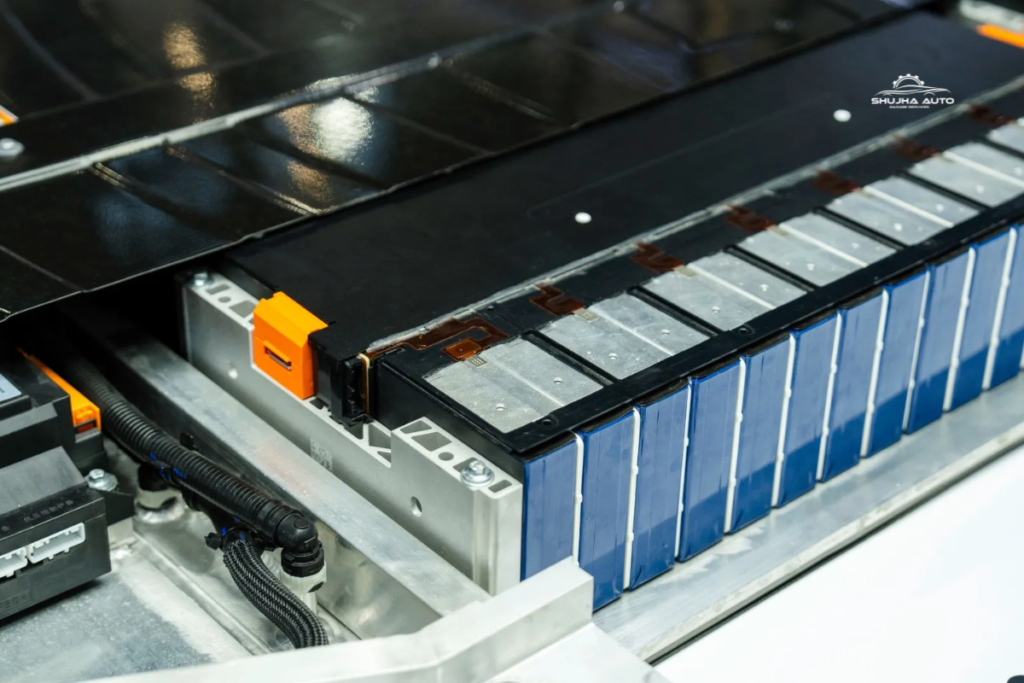
When you bring your EV to our garage, we don’t just guess. We use specialized diagnostic computers that speak directly to your car’s battery management system. We can read the health of every single module inside the pack.
The process looks like this:
- We Scan: We plug in our high-end EV diagnostic tool. We look at the State of Health (SOH) reading. This tells us exactly how much life is left in the pack compared to when it was new.
- We Identify: Sometimes, the problem isn’t the whole battery. It’s one bad cell or one weak module. Modern EV batteries are made of many small modules.
- We Decide the Path:
- Minor Issue: A software reset or update fixes the problem. (This happens more often than you think).
- Module Failure: If one module is weak, we can often replace just that module. This is much cheaper than replacing the whole pack.
- Cell Balancing: Sometimes the cells are just unbalanced. We can perform a long, slow balance charge to bring them back into line.
If the issue is serious and the car is still under the manufacturer’s warranty, we will document the fault, provide you with the diagnostic report, and guide you through the warranty claim process with the dealer. If the car is out of warranty, we sit down with you and discuss your options clearly and honestly.
At Shujha Auto Garage Services, we don’t believe in shock and awe repairs. We believe in fixing exactly what is wrong and nothing more.
Busting the Myth of the Expensive Replacement
Yes, if you walk into a luxury dealership in 2019 and ask for a brand-new, official OEM battery pack for an out-of-warranty luxury sedan, the invoice might make you faint. However, the market is changing rapidly.
Here is the reality check:
- Most people never replace the battery. As we discussed earlier, the battery outlasts the car for most owners.
- The aftermarket is growing. Just like you can buy a remanufactured engine for a Toyota Camry, companies are now offering remanufactured EV battery packs. These are used packs that have been tested, reconditioned, and are sold for a fraction of the new price.
- Module repair is the future. As we mentioned, we can often fix a pack by swapping one module, not the whole thing. This costs thousands, not tens of thousands.
The cost of batteries is dropping every single year. By the time your 2030 car needs a battery in 2040, the price will be a fraction of what it is today.
The Free Diagnostic Check – What’s Actually Included?
You might have seen our ad for a Free Diagnostic Check for electric vehicles at Shujha Auto Garage Services.
You might be wondering: Is it actually free? Or are there hidden fees or charges?
This is a very fair question. In the automotive world, free check sometimes means we will find something broken and charge you to fix it. We want to be completely transparent with you.
Are there any hidden fees or charges?
No. Zero. None. The health check is 100% complimentary. You will not receive a bill for the time our technician spends plugging into your car. There is no fine print.
So, What’s included in the free diagnostic check?
When you bring your EV to us for a battery health check, this is exactly what we do:
- State of Health (SOH) Reading: This is the main event. We read the actual, current capacity of your high-voltage battery. We tell you exactly what percentage of life is remaining. This is the number that matters most for EV battery life expectancy.
- Cell Voltage Variance Check: We scan all the individual cells in your pack. A healthy battery has cells that are all very close in voltage. If one cell is drifting away from the others, it’s a warning sign. We catch it early.
- Insulation Test: We check the high-voltage system for any leaks. Safety first.
- Coolant System Check: Most EV batteries are liquid-cooled. We check the temperature sensors and coolant levels to ensure the thermal management system is working.
- Charging System Test: We check that your on-board charger is communicating properly with the battery and accepting power correctly.
- Clear Explanation: We sit down with you and show you the results on our screen. We don’t use confusing codes. We explain it in plain English.
No hidden fees. No upsell pressure. Just facts, so you can drive with confidence.
Why Shujha Auto Garage Services?
You might be reading this and thinking, This all sounds great, but can I really trust a garage with my EV?
We understand that hesitation. Electric cars are high-tech, and you don’t want a mechanic who learned on carburetors touching your 800-volt system.
Here is why drivers trust us:
- We Are Certified EV Technicians:
We haven’t just watched YouTube videos. We have invested in the training and the tools required to work on high-voltage vehicles safely and effectively. We respect the electricity in these cars, and we follow strict safety protocols.
- We Own the Right Tools:
You can’t diagnose an EV with a wrench and a code reader from Amazon. We have invested in professional-grade diagnostic software that speaks the language of Tesla, BYD, Hyundai, Kia, MG, Nissan, and BMW.
- We Are Enthusiasts:
We love EVs. The team at Shujha Auto Garage Services drives them, charges them, and studies them. We aren’t just fixing your car; we are passionate about the technology.
- We Are Transparent:
We believe that an informed customer is a happy customer. We will never recommend a repair you don’t need. If your battery is healthy, we will tell you it’s healthy. If we see a minor issue, we will tell you how to monitor it and when to worry.
Quick FAQ for New EV Owners
Q: Is it bad to use public fast chargers?
A: No. It’s not bad. It is slightly harder on the battery than slow charging, but it is designed for it. Use fast chargers when you need them, but use slow charging at home when you don’t.
Q: Should I let my EV battery run to zero before charging?
A: No. Unlike old NiMH batteries, lithium-ion does not have a memory effect. Running to zero frequently puts stress on the pack. Charge when it’s convenient.
Q: Does cold weather damage the battery?
A: Cold weather reduces range temporarily (the car uses energy to heat the battery), but it does not cause permanent EV battery degradation. Heat is the real enemy.
Q: My range dropped after a software update. Is my battery dying?
A: Probably not. Manufacturers sometimes update the software to give you a more accurate reading, or to reserve a little more buffer at the top and bottom to protect the battery. Your range might actually go up again in the next update.
Q: Can you check my battery even if the check engine light isn’t on?
A: Absolutely. You don’t need a warning light to check the health of your battery. Many owners come to us just for peace of mind. We recommend a health check once a year, just like an annual physical.
The Future is Electric, and the Future is Bright
When we first started Shujha Auto Garage Services, EVs were rare. Now, we see them every single day. The technology has matured. The fear surrounding EV battery life expectancy is fading, replaced by real-world data showing that these cars are incredibly durable.
Think about it this way:
Your phone battery is tiny, gets charged every single day, and is often treated poorly. It still lasts 2-3 years.
Your EV battery is massive, has active cooling, has sophisticated management software, and has a huge buffer zone. It is designed to last a decade or more.
Stop worrying. Start driving.
You didn’t buy an electric car to stress about the battery. You bought it to enjoy the silent acceleration, the lower running costs, and the environmental benefits.
Let Shujha Auto Garage Services Be Your EV Partner
Whether you are a new EV owner or a seasoned pro, we are here to help.
If you are concerned about EV battery degradation, or if you just bought a used EV and want to know exactly what you’re working with, stop by Shujha Auto Garage Services.
We offer:
- Complimentary EV Battery Health Checks – Know your State of Health for free.
- High-Voltage System Diagnostics – We find the root cause.
- Module and Pack Repair – Save money by fixing, not replacing.
- Regular Maintenance – Tires, suspension, brakes, and AC. We do it all.
Don’t let battery anxiety ruin the joy of electric driving.
Visit us today, or give us a call to book your free diagnostic check. Let us show you why Shujha Auto Garage Services is the name EV owners trust for honest, professional, and expert care.
Drive Electric. Drive Confident. Drive to Shujha.Disclaimer: Specific EV battery life expectancy varies by make, model, driving habits, and climate. Always consult your owner’s manual and warranty documentation for specific recommendations regarding your vehicle.