


CVT gearbox oil change improves performance, extends transmission life, and ensures smooth driving. Get expert CVT gearbox oil change service today.
If you drive a modern car, there is a good chance it has a CVT gearbox. You might not know what CVT stands for, but you probably know how important it is to keep your car running smoothly. The gearbox, or transmission, is the heart of your car’s driving system. If it fails, the car simply stops moving.
At Shujha Auto Garage Services, we see too many cars come in with damaged CVT gearboxes simply because the owner forgot to do one small thing: change the oil.
I will use simple, easy words to explain what a CVT is, why it needs care, and exactly how to perform a CVT transmission oil change the right way. By the end of this post, you will know how to avoid a massive repair bill and keep your car driving like it is brand new.
What is a CVT Gearbox? (And Why It’s Different)
Before we talk about the oil, let’s talk about the gearbox. For many years, cars used normal automatic transmissions. Those gearboxes used metal gears that clunked into place. A CVT (Continuously Variable Transmission) is different. It doesn’t have gears.
Imagine two cones connected by a strong metal belt. The belt slides up and down the cones to change the “ratio.” This is why when you drive a CVT car, you don’t feel the car shifting. It just glides. It feels smooth because it is smooth.
However, this design relies entirely on friction and hydraulic pressure. That pressure comes from the transmission fluid. Because there are no traditional gears, the fluid inside a CVT works much harder than fluid in a normal automatic car.
This is why CVT fluid replacement is not just a suggestion; it is a necessity for survival of the gearbox.
Why CVT Fluid is the Lifeline of Your Car
In a standard engine, oil lubricates the moving parts. In a CVT gearbox, the fluid does three very important jobs:
- Lubrication: It keeps the metal belt and pulleys from grinding against each other.
- Cooling: The friction inside a CVT creates massive heat. The fluid carries that heat away.
- Friction Control: This is the tricky part. CVT fluid needs to be slippery enough to lubricate, but sticky enough to allow the belt to grip the pulleys. If the fluid loses its specific properties, the belt starts to slip.
When the fluid gets old, it turns dark, smells burnt, and loses its ability to create friction. Once that happens, the metal belt starts to wear down. Tiny metal shavings float around in the fluid, clogging up the delicate valves inside the transmission.
If you ignore this long enough, the gearbox will fail. Replacing a CVT gearbox can cost as much as a small used car. Changing the fluid costs a fraction of that.
When Should You Change Your CVT Fluid?
There is a lot of confusion about when to do a CVT gearbox service. Some car manufacturers say the fluid is lifetime. I want to be very clear with you: there is no such thing as lifetime fluid. “Lifetime” usually means the lifetime of the warranty, not the lifetime of the car.
Here is a simple rule of thumb that we use at Shujha Auto Garage Services:
- Normal Driving: Every 60,000 kilometers (or 40,000 miles).
- Harsh Driving: Every 40,000 kilometers (or 25,000 miles).
What is harsh driving? If you live in a city with a lot of traffic jams, if you drive in very hot weather, if you tow a trailer, or if you have a heavy foot on the accelerator—you fall into the harsh driving category.
If you buy a used car with a CVT and you don’t know when the fluid was last changed, change it immediately. It is the best insurance policy you can buy for your car.
Location: Please Visit Our Shujha Auto Garage
The Risks of Ignoring Your CVT
I cannot stress this enough. Neglecting your CVT is a gamble with very high stakes. Here is what happens if you ignore the maintenance schedule:
1. Slipping
The first sign is usually a slipping feeling. You press the gas, the engine revs up high, but the car doesn’t accelerate as fast as it should. This means the belt is losing grip on the pulleys.
2. Overheating
Old fluid doesn’t cool well. If the gearbox overheats, your car will go into limp mode. This is a safety feature where the car limits your speed to protect itself. You will be stuck driving at 30 or 40 km/h on the highway.
3. Shuddering
You might feel a vibration or shaking when you accelerate from a stop. This is often caused by contaminated fluid.
4. Complete Failure
Eventually, the belt snaps or the valve body gets clogged. At this point, the car won’t move forward or backward at all. The repair is a full transmission replacement.
The Step-by-Step Process of a Professional CVT Gearbox Oil Change
Now, let’s get into the details. If you are a DIY enthusiast, you might attempt this at home. However, a CVT is not forgiving. If you use the wrong fluid or don’t do the procedure correctly, you can destroy the gearbox instantly.
Here is how we perform a CVT transmission oil change here at Shujha Auto Garage Services.
Step 1: The Diagnostic Check
Before we even drain a single drop of oil, we do a full inspection. We never assume that an oil change will fix a problem.
What’s included in the free diagnostic check?
When you bring your car to us, we start with a complimentary (free) diagnostic check. This is not just a visual glance. It includes:
- Scanning the Transmission Control Unit (TCU): We plug in a professional scanner to see if the computer has recorded any error codes. Even if your “Check Engine” light isn’t on, there might be pending codes that indicate internal slippage.
- Fluid Inspection: We check the color and smell of the current fluid. If it smells like burnt toast, that is a bad sign.
- Test Drive: We take the car for a short drive to feel how the gearbox is performing. We look for hesitation, hard shifts, or noise.
- Visual Inspection: We check for leaks around the transmission pan and the seals.
We do this for free because we want to know exactly what condition your gearbox is in before we start. If there is a serious internal problem, changing the oil might not fix it—and we want to be honest with you about that before we charge you for a service.
Step 2: Gathering the Right Materials
This is the most critical step. CVT fluid replacement is not like engine oil. You cannot put “universal” fluid in a CVT.
Every manufacturer has a specific type of fluid.
- Nissan uses NS-2 or NS-3 fluid.
- Honda uses HCF-2 fluid.
- Toyota uses CVT Fluid TC or FE.
- Mitsubishi/Subaru have their own specific blends.
If you mix them up, the friction properties change. If the fluid is too slippery, the belt slips. If it is not slippery enough, the gearbox overheats.
We only use genuine or OEM-spec fluids at Shujha Auto Garage Services. We also replace the strainer (filter) and the pan gasket. Many garages skip the filter to save money, but that is a mistake. The filter catches metal shavings; if it is clogged, the new fluid can’t flow properly.
Step 3: Draining the Old Fluid
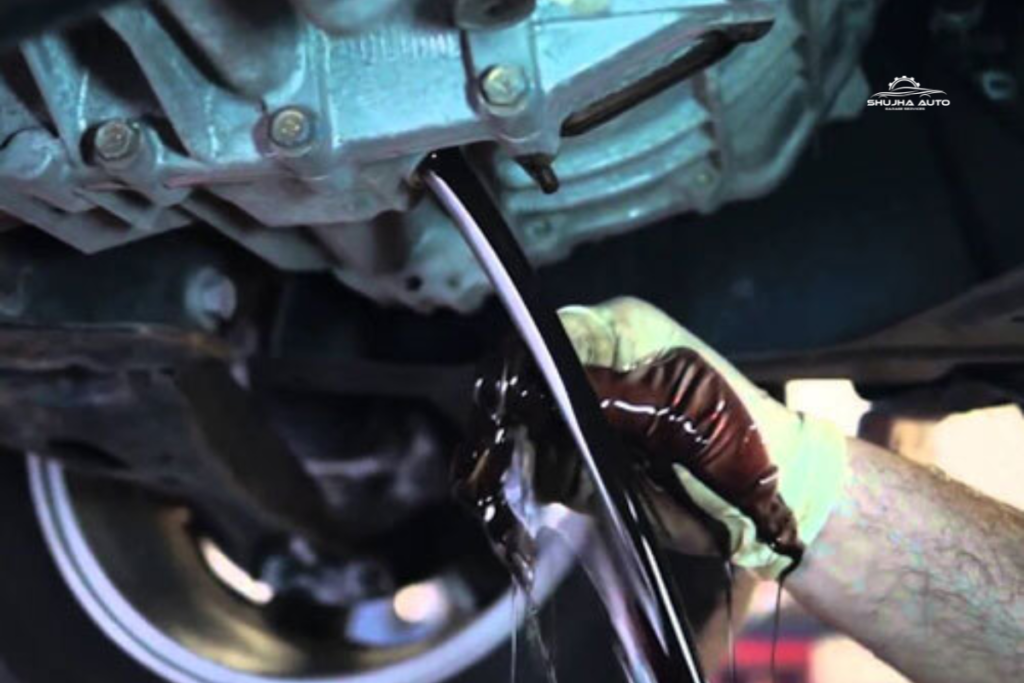
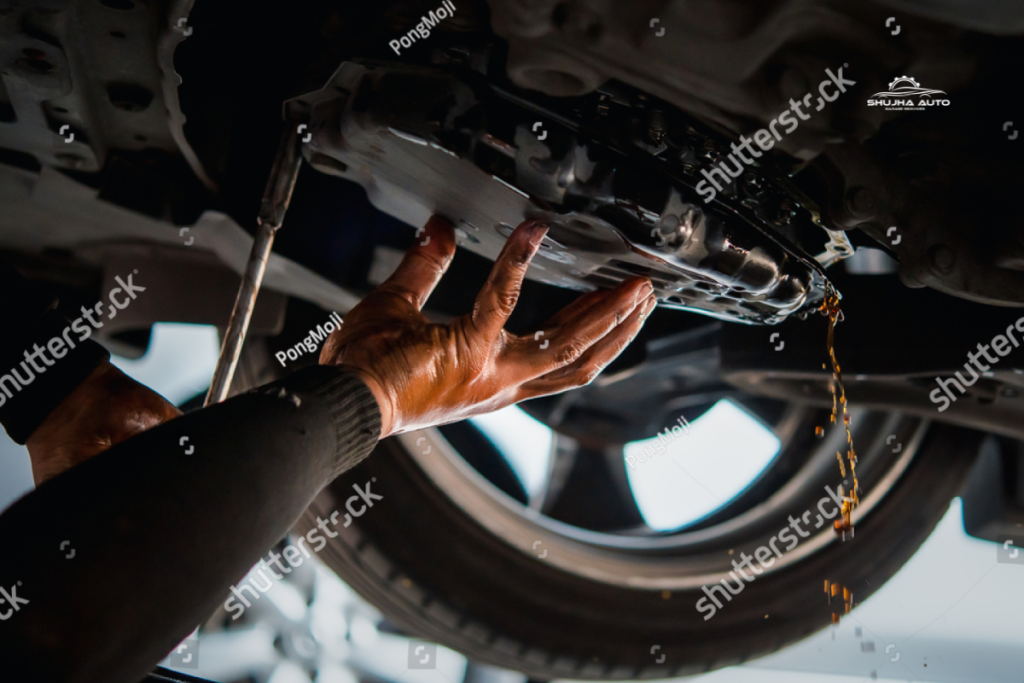
We lift the car safely and remove the transmission pan. When we remove the pan, we don’t just let the fluid drain; we inspect the pan itself.
If we see a thin layer of black sludge on the magnet inside the pan, that is normal wear. If we see chunks of metal or a lot of glitter (metal shavings), that is a sign that the gearbox is already damaged. What happens if an issue is found? If we find metal chunks or major damage during the free diagnostic or while draining the fluid, we stop and have a conversation with you.
We never proceed with a service if the gearbox is already failing. We will explain exactly what we saw, show you the evidence, and discuss your options. Sometimes a flush can make an already dying transmission worse. We value honesty over making a quick sale. If a repair is needed, we will give you a clear quote before touching anything further.
Step 4: Replacing the Filter and Cleaning
We remove the old strainer (filter) and throw it away. We then clean the transmission pan thoroughly, wipe the magnets clean, and remove any old gasket material. A clean pan ensures the new fluid stays clean longer.
Step 5: Refilling and the Learning Procedure
This is where the skill comes in. You cannot just pour fluid in and send the car out.
We refill the transmission with the exact amount of new, high-quality fluid. Then, we start the engine and let it idle. We use a scan tool to monitor the transmission fluid temperature.
CVT fluid expands when it heats up. If you check the level when it is cold, you will get the wrong reading. We wait until the fluid reaches the exact temperature specified by the manufacturer (usually between 35°C and 45°C). Then, we open the overflow plug to ensure the level is perfect.
Too much fluid causes foaming. Too little fluid causes slippage. Getting the level exactly right is essential.
Step 6: The Test Drive and Final Check
After the service, we take the car for another test drive. We want to ensure that the CVT gearbox service was successful. We check for smooth acceleration and look for any leaks around the pan.
Common Myths About CVT Fluid Changes
There are a lot of rumors out there that scare people away from maintaining their cars. Let me clear up a few myths.
Myth 1: If you haven’t changed it in 100,000 km, don’t change it at all.
Some people say that changing old fluid will cause the transmission to slip because the old fluid had grit helping the clutches grip. This is false for CVTs. If the fluid is that old, the gearbox is on borrowed time. Changing the fluid will not fix existing damage, but it will prevent further damage. Leaving the old, burnt fluid in there guarantees failure.
Myth 2: Any transmission fluid is fine.
Absolutely not. Using the wrong fluid is the fastest way to destroy a CVT. It usually takes less than 1,000 km for damage to occur if the wrong fluid is used. Always check the bottle or ask a professional.
Myth 3: Flushing is bad.
A power flush using a machine can sometimes stir up sediment in old transmissions. At Shujha Auto Garage Services, we prefer the drain and fill method combined with a filter change. We do not use harsh chemical flushes unless the fluid is still in good condition. We prioritize safety over speed.
What to Expect During a Service Visit
If you have never had a CVT transmission oil change before, you might feel nervous about going to a garage. You might be worried about the cost or whether you are being told the truth.
When you come to Shujha Auto Garage Services, we want you to feel at ease. Here is how we operate:
- Welcome and Check-in: You arrive, and we greet you. We take down your car’s details and your concerns.
- Free Diagnostic Check: As mentioned, we perform a thorough check. We don’t charge you for this because we believe you should know what is wrong with your car before you agree to pay for a repair.
- Transparent Quote: Once we know what the car needs, we provide a clear quote. We list the cost of the fluid, the filter, the gasket, and the labor. Are there any hidden fees or charges? No. At Shujha Auto Garage Services, we believe in transparency. The price we quote is the price you pay. We will never surprise you with an “environmental fee,” “shop supply fee,” or any other hidden charge. If we find something unexpected during the work (like a stripped drain plug), we will call you immediately to explain and get your approval before doing any extra work.
- The Service: Our technicians perform the step-by-step process listed above.
- Quality Check: After the service, a senior technician double-checks the fluid level and test drives the car.
- Delivery: We hand the car back to you, explain what we did, and advise you on when your next service should be.
How to Recognize a Good Garage for CVT Work
Not all garages are the same. Because CVTs are so sensitive, you need to choose a garage that knows what they are doing. Here are a few signs that you are in the right place:
- They use a scan tool: If a garage doesn’t scan your car before a CVT service, walk away. The computer tells the story of the gearbox’s health.
- They wait for the temperature: If they fill the fluid cold and send you off without checking the temperature, they are doing it wrong.
- They replace the filter: A CVT gearbox service is incomplete without a new filter.
- They show you the old parts: We like to show customers the old fluid and the old filter. Seeing the condition helps you understand why the service was necessary.
The Cost of Neglect vs. The Cost of Maintenance
Let’s do a simple comparison.
- Cost of a CVT fluid replacement: Usually ranges depending on the car make and the amount of fluid needed. It is a standard maintenance cost, similar to a major engine oil service.
- Cost of a CVT replacement: This can be anywhere from 5 to 10 times the cost of a fluid change, depending on whether you buy a new, rebuilt, or used gearbox.
Furthermore, if your CVT fails, you are without a car for days or even weeks while parts are ordered. If you maintain it, your car remains reliable.
Think of a CVT transmission oil change as a cheap insurance policy. You are paying a small amount now to protect a very expensive component.
Special Tips for Used Car Buyers
If you are reading this because you just bought a used car with a CVT, congratulations! But you need to act fast.
When you buy a used car, you don’t know how the previous owner drove it. They might have towed a heavy trailer or ignored the service light.
Here is my advice:
- Immediately take the car to a garage for a free diagnostic check.
- Ask for a CVT fluid replacement as soon as possible.
- If the fluid looks dark red or brown, change it now. If it looks pink and smells sweet, you might be okay—but if you don’t know the history, it is safer to change it anyway.
We see many used cars come into Shujha Auto Garage Services with transmission issues that could have been prevented if the previous owner had simply changed the fluid on time. Don’t let that be you.
Why Choose Shujha Auto Garage Services?
You have many choices when it comes to car maintenance. But when it comes to a delicate system like a CVT gearbox, you want experience, honesty, and precision.
Here is why drivers trust us:
- Specialized Knowledge: We don’t treat CVTs like regular automatics. We understand the specific requirements of Nissan, Honda, Toyota, Mitsubishi, Subaru, and other CVT-equipped vehicles.
- No Hidden Fees: We promised this earlier, but it bears repeating. Are there any hidden fees or charges? No. Our quotes are final. We believe that trust is built on transparency.
- Free Diagnostic Check: We take the guesswork out of the equation. What’s included in the free diagnostic check? A full computer scan, a road test, a fluid analysis, and a visual inspection. This gives you the full picture of your gearbox’s health before you spend a dirham.
- Honest Advice: If an issue is found during the check—such as a failing valve body or a worn belt—we don’t hide it. We explain your options clearly. Sometimes a fluid change is enough; sometimes a repair is needed. We tell you the truth, even if it means we don’t get the job that day.
- Quality Parts: We use genuine filters and the exact fluid specified by your car’s manufacturer. We do not cut corners.
Frequently Asked Questions
To wrap up this guide, let’s answer some of the questions we hear every day at the garage.
Q: How long does a CVT gearbox service take?
A: Typically, it takes about 1.5 to 2 hours. This includes the diagnostic check, draining, cooling, refilling, and the temperature-sensitive level check.
Q: Can I change the CVT fluid myself?
A: If you are very mechanically inclined and have a flat driveway, a scan tool to read fluid temperature, and the ability to dispose of old oil safely, you can. However, because CVTs are so sensitive to fluid type and level, we recommend leaving it to professionals. A mistake can cost you a transmission.
Q: Will a CVT fluid change make my car shift smoother?
A: Usually, yes. Fresh fluid restores the hydraulic pressure and friction properties. If your car was jerking slightly before, a CVT fluid replacement often smooths it out. However, if the jerking is caused by a mechanical fault (like a worn belt), a fluid change won’t fix that.
Q: How do I know what fluid my car needs?
A: Check your owner’s manual. If you don’t have the manual, call us. We have a database of all manufacturers’ specifications. We can tell you exactly what your car needs over the phone.
Q: What if my car has high mileage and the fluid has never been changed?
A: It is a delicate situation. We will perform a free diagnostic check first. If the fluid is very burnt but the transmission is still functioning okay, a gentle drain and fill (without a power flush) is usually the safest approach. We will guide you based on what we find.
Conclusion: Smooth Driving Starts Here
Your car is likely one of the most expensive things you own, next to your home. Keeping it on the road shouldn’t be a source of stress. The CVT gearbox is a marvel of engineering—it provides smooth acceleration and great fuel economy—but it demands respect and care.
By sticking to a regular schedule of CVT transmission oil change, you ensure that the belt stays gripping, the pulleys stay cool, and the valves stay clean. You avoid the nightmare of a breakdown on the highway and the shock of a multi-thousand-dollar repair bill.
At Shujha Auto Garage Services, we are passionate about keeping your car running like new. We combine technical expertise with honest, straightforward service.
We don’t believe in hidden fees. We don’t believe in selling you services you don’t need. We believe in getting the job done right the first time, using the right tools, the right fluids, and the right knowledge.
If you are feeling any hesitation in your CVT, or if you simply don’t remember the last time you had the fluid changed, it is time to act.
Visit Shujha Auto Garage Services today.
Let us give you a free diagnostic check to assess the health of your gearbox. Whether you need a simple CVT fluid replacement or a more complex repair, we are here to help you drive away with confidence.
Remember, smooth driving isn’t just about comfort; it’s about safety and reliability. Keep your CVT happy, and it will keep you moving for years to come.