




A car shaking while driving can make even a short journey uncomfortable and stressful. You may feel vibrations through the steering wheel, seat, floor, or the entire vehicle. Sometimes the shaking starts only at high speed, while other times it happens during acceleration, braking, turning, or even when the car is stopped.
Many drivers ignore minor vibrations because their car is still running normally. However, unusual shaking can be an early warning of tyre problems, unbalanced wheels, damaged suspension parts, worn brakes, engine issues, or transmission faults. Some causes are simple to repair, while others can affect driving safety if ignored.
The most important thing is to understand when the shaking happens and where you feel it.
In this guide, we will explain why your car shakes while driving, common causes, warning signs, possible solutions, and when to visit Auto Garage Services in Sharjah for car vibration diagnosis, wheel balancing, suspension inspection, brake repair, engine diagnostics, or car maintenance service.
Quick Answer: Why Is My Car Shaking While Driving?
Your car may shake while driving because of unbalanced wheels, damaged tyres, bent rims, worn suspension parts, brake disc problems, faulty engine mounts, engine misfires, worn CV joints, or transmission issues.
The cause often depends on when the vibration occurs.
- Shaking at high speed: Usually related to wheel balancing, tyres, or bent rims.
- Shaking while braking: Often points to brake disc, brake pad, or braking system problems.
- Shaking while accelerating: May indicate CV joint, driveshaft, engine, or transmission issues.
- Shaking while idling: Can result from engine mounts, misfires, or rough engine operation.
- Shaking while turning: May indicate CV joints, steering components, or suspension problems.
A proper inspection is the safest way to identify the cause and prevent unnecessary repairs.
Why Your Car Shakes at Different Speeds
Not every car vibration has the same cause. The speed, driving condition, and location of the vibration can help narrow down the problem.
Car Shaking at High Speed
If your car starts vibrating around 80–120 km/h, wheel imbalance is one of the first things to inspect.
Small differences in wheel weight become more noticeable as the wheels rotate faster. This can cause vibrations through the steering wheel, floor, or seats.
Other possible causes include damaged tyres, bent wheels, worn suspension parts, or driveshaft problems.
Car Shaking at Low Speed
If your car shakes at low speed, especially with a repeated thumping sensation, the problem may involve a damaged tyre, bent rim, or wheel that is not rotating evenly.
A tyre with internal damage can create vibration even at relatively low speeds.
Car Shaking While Accelerating
If the shaking becomes stronger when you press the accelerator, the problem may be related to the drivetrain or engine.
Common causes include worn CV joints, damaged driveshafts, engine misfires, faulty engine mounts, or transmission problems.
Car Shaking While Braking
If your car drives smoothly but starts shaking when you apply the brakes, inspect the braking system.
Brake disc thickness variation, excessive disc runout, uneven pad deposits, or worn braking components can create vibration through the steering wheel or brake pedal.
Car Shaking While Idling
If your car shakes while stopped at a traffic light, the problem may not involve the wheels.
Engine misfires, worn engine mounts, irregular idle speed, or engine performance issues can cause vibrations while the vehicle is stationary.
Common Causes of Car Shaking While Driving
There are several possible reasons behind car vibrations. Some are related to tyres and wheels, while others involve suspension, brakes, engine, or transmission components.
1. Unbalanced Wheels
Unbalanced wheels are among the most common causes of car shaking at highway speeds.
Each wheel and tyre assembly should rotate evenly. When its weight distribution is uneven, vibration can develop as speed increases.
Signs of unbalanced wheels include:
- Steering wheel shaking at high speed
- Vibration through the seats
- Shaking at certain speed ranges
- Uneven tyre wear
- Vibration after tyre replacement
Solution: Professional wheel balancing can correct uneven weight distribution. A technician uses balancing equipment to identify where corrective wheel weights are needed.
2. Damaged or Uneven Tyres
Tyres play an important role in smooth driving. If a tyre is damaged, worn unevenly, or has an internal structural problem, the car may shake.
Common tyre problems include:
- Uneven tread wear
- Tyre bulges
- Flat spots
- Internal belt separation
- Incorrect tyre pressure
- Tyre deformation
A damaged tyre can create a repeated thumping sensation, vibration, or unstable handling.
Solution: Have the tyres inspected for damage, pressure, and tread condition. A tyre with structural damage generally requires replacement rather than balancing.
3. Bent or Damaged Rims
A bent wheel rim can cause vibrations because the wheel no longer rotates evenly.
Bent rims commonly occur after hitting a pothole, curb, or road obstacle.
Signs include steering vibration, uneven tyre movement, pressure loss, or shaking at particular speeds.
Solution: A technician should inspect wheel runout and structural condition. Some rims may be repairable, while severely damaged wheels require replacement.
4. Wheel Alignment Problems
Wheel alignment controls the angles at which the wheels meet the road.
Incorrect alignment commonly causes the car to pull to one side, the steering wheel to sit off-centre, or the tyres to wear unevenly.
Although alignment problems may contribute to poor handling and vibration indirectly, wheel imbalance is a more typical cause of speed-related shaking.
Solution: Inspect tyre condition and suspension components before carrying out wheel alignment. Alignment adjustments should meet manufacturer specifications.
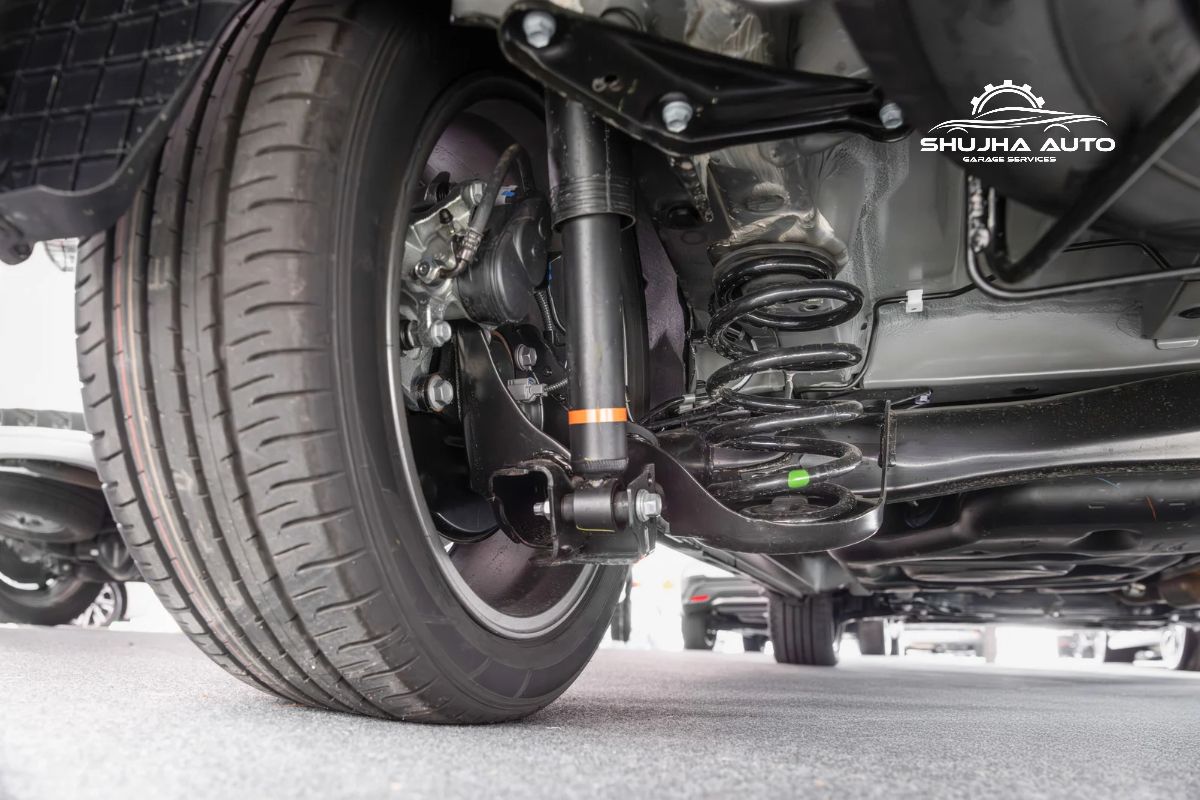
5. Worn Suspension Parts
The suspension system absorbs road shocks and helps maintain stability.
When suspension parts become loose, worn, or damaged, the car may feel unstable or vibrate over rough roads.
Common suspension problems include:
- Worn shock absorbers
- Damaged control arms
- Worn bushings
- Loose ball joints
- Damaged stabilizer links
- Faulty struts
You may also notice knocking sounds, uneven tyre wear, or poor handling.
Solution: A complete suspension inspection can identify damaged components. Repairing or replacing the worn parts helps restore stability.
6. Brake Disc Problems
If your car shakes when braking, the brake discs and related components should be checked.
Brake discs can develop uneven thickness or excessive runout, creating a pulsating feeling during braking.
Common symptoms include:
- Steering wheel vibration while braking
- Brake pedal pulsation
- Shaking during high-speed braking
- Brake noise
- Uneven braking response
Solution: The technician should inspect brake disc thickness, runout, pads, and calipers. Depending on the condition and manufacturer limits, discs may require machining or replacement.
7. Faulty Engine Mounts
Engine mounts hold the engine securely and reduce vibrations transmitted into the vehicle.
When the mounts wear out, the engine can move excessively, causing noticeable shaking.
Signs of bad engine mounts include:
- Vibration while idling
- Shaking when shifting into Drive or Reverse
- Engine movement during acceleration
- Clunking sounds
- Increased cabin vibration
Solution: Damaged engine mounts should be inspected and replaced when necessary.
8. Engine Misfires
An engine misfire occurs when one or more cylinders fail to produce power properly.
This can make the engine run unevenly and cause shaking during acceleration or idling.
Possible causes include:
- Worn spark plugs
- Faulty ignition coils
- Dirty fuel injectors
- Fuel delivery problems
- Sensor faults
- Engine compression problems
Other symptoms may include rough idle, poor acceleration, reduced fuel economy, and a check engine light.
Solution: An engine diagnostic scan and further testing can identify the misfire’s cause.
9. Worn CV Joints
Constant velocity joints, commonly called CV joints, transfer power to the wheels while allowing movement during steering and suspension travel.
When a CV joint becomes worn, it can cause clicking, vibration, or shaking.
An outer CV joint often produces clicking sounds during turns. An inner CV joint can sometimes cause vibration during acceleration.
Solution: Inspect the CV joints, axle shafts, and protective boots. Damaged components may require replacement.
10. Driveshaft Problems
A damaged, bent, or unbalanced driveshaft can cause vibrations, particularly during acceleration or at certain speeds.
This is more relevant to some rear-wheel-drive and all-wheel-drive vehicles.
Possible symptoms include:
- Vibration under acceleration
- Shuddering through the floor
- Clunking sounds
- Increasing vibration with speed
- Unusual drivetrain noise
Solution: Driveshaft inspection may reveal worn joints, damaged bearings, imbalance, or other mechanical problems.
11. Transmission Problems
Transmission problems can sometimes feel like car vibration.
Automatic transmissions and CVT gearboxes may produce shuddering during acceleration, gear engagement, or particular driving conditions.
Common signs include:
- Jerking during gear changes
- Shuddering while accelerating
- Delayed gear engagement
- RPM changing unexpectedly
- Transmission warning light
- Unusual gearbox noise
Solution: Transmission diagnostics can help identify fluid-related, mechanical, or electronic problems.
12. Wheel Bearing Problems
Wheel bearings allow the wheels to rotate smoothly.
When a wheel bearing becomes worn, it may produce humming, grinding, vibration, or looseness.
The noise often changes with vehicle speed and may become more noticeable during turns.
Solution: A technician should inspect the wheel bearing and related hub components. A damaged bearing usually requires replacement.
Why Is My Steering Wheel Shaking?
Steering wheel vibration is a common complaint, especially during highway driving.
If the steering wheel shakes at a particular speed, front wheel imbalance is a likely cause.
However, steering wheel vibration may also result from:
- Damaged front tyres
- Bent rims
- Worn steering components
- Loose suspension parts
- Brake disc problems
- Wheel bearing wear
The important question is whether the steering wheel shakes while cruising, braking, accelerating, or turning.
For example, shaking during braking suggests a different problem from shaking at a constant highway speed.
Why Is My Car Shaking After Changing Tyres?
If vibration starts immediately after tyre replacement, the first things to inspect are wheel balancing, tyre seating, tyre condition, wheel fitment, and wheel fastener torque.
A newly installed tyre may also have a manufacturing or structural issue that affects how smoothly it rotates.
Do not assume that new tyres automatically mean the wheels are properly balanced.
A professional tyre inspection and balancing check can help identify the problem.
Why Is My Car Shaking With the AC On?
A slight change in engine vibration when the AC compressor engages can be normal, particularly in smaller vehicles.
However, strong shaking is not normal.
Possible causes include worn engine mounts, rough idle, engine misfires, compressor-related mechanical problems, or idle control issues.
If the car shakes mainly when the AC is switched on, the engine and AC system should be inspected together.
Is It Safe to Drive a Car That Is Shaking?
Whether it is safe depends on the severity and cause of the vibration.
Mild vibration from wheel imbalance may allow careful travel to a nearby garage, but it should still be inspected promptly.
Strong or sudden shaking can indicate a serious safety issue.
Stop driving safely and arrange recovery if you notice:
- Severe or rapidly worsening vibration
- A tyre bulge or visible tyre damage
- Steering becoming difficult to control
- Loud grinding or knocking
- Unstable braking
- A loose or visibly damaged wheel
- A flashing check engine light with severe shaking
- Overheating or significant power loss
Do not continue highway driving when the vehicle feels unstable.
What Should You Check First?
Before booking repairs, a few simple observations can help explain the problem.
Check Tyre Pressure
Use the manufacturer’s recommended tyre pressures, ideally measured when the tyres are cold.
Low or uneven pressure can affect handling and driving comfort.
Inspect Visible Tyre Damage
Look for bulges, cuts, unusual wear, or objects stuck in the tyre.
Do not drive on a tyre with visible structural damage.
Notice the Speed
Pay attention to whether the vibration occurs at low speed, highway speed, or during acceleration.
This information helps the technician narrow down the possible causes.
Identify Where You Feel It
Steering wheel vibration may suggest a front wheel or steering-related issue.
Vibration through the seats or floor may point towards rear wheels or drivetrain components, although this is not a definite diagnosis.
Check Warning Lights
If the check engine light, ABS light, or another warning appears with shaking, diagnostic testing may be required.
What Happens During Car Vibration Diagnosis?
A professional inspection is the best way to identify why your car is shaking.
At Auto Garage Services in Sharjah, car vibration diagnosis may involve:
- Tyre condition inspection
- Tyre pressure check
- Wheel balancing assessment
- Wheel alignment assessment
- Bent rim inspection
- Suspension component inspection
- Steering system inspection
- Brake disc and pad inspection
- Engine mount inspection
- Engine diagnostic scanning
- CV joint and driveshaft inspection
- Transmission inspection
- Wheel bearing inspection
- Road testing when safe
The technician can use the symptoms to determine which components need detailed testing.
For example, if the car shakes only when braking, the braking system should be checked before replacing tyres or engine parts.
This approach helps avoid unnecessary repairs.
Common Fixes for Car Shaking While Driving
The correct repair depends on the cause. Not every vibration problem requires expensive replacement parts.
Wheel Balancing
Wheel balancing corrects uneven weight distribution in the wheel and tyre assembly. It is one of the first services considered for speed-related vibration.
Tyre Replacement
A damaged, severely worn, or structurally defective tyre may need replacement.
Wheel Alignment
Alignment correction can improve steering direction, handling, and uneven tyre wear when incorrect wheel angles are identified.
Suspension Repair
Replacing worn bushings, control arms, ball joints, shocks, or other damaged suspension components can help restore stability.
Brake Repair
Brake disc, pad, or caliper repair may be necessary when vibration occurs during braking.
Engine Repair
If engine misfires or faulty mounts are responsible, the affected engine components should be repaired after diagnosis.
Drivetrain Repair
Worn CV joints, damaged driveshafts, or transmission faults require repairs suited to the specific component and vehicle model.
Car Shaking While Driving in UAE Conditions
Driving in the UAE creates particular challenges for tyres, wheels, and vehicle maintenance.
High summer temperatures, long highway journeys, road debris, and frequent driving can make existing tyre or suspension problems more noticeable.
Drivers around Sharjah, Dubai, and industrial areas should pay particular attention to tyre condition, correct tyre pressure, wheel damage, and suspension performance.
If your vehicle regularly travels at highway speeds, even a small wheel imbalance may become uncomfortable.
Regular inspections can help identify problems before they affect driving safety.
How to Prevent Car Vibration Problems
Good maintenance habits can reduce the risk of unexpected shaking.
Maintain Correct Tyre Pressure
Check tyre pressure regularly and follow the vehicle manufacturer’s recommendations.
Balance Wheels When Needed
Wheel balancing is important after tyre fitting and when speed-related vibration develops.
Check Wheel Alignment
If the car pulls to one side, steering is off-centre, or tyres wear unevenly, have the alignment checked.
Avoid Hard Impacts
Slow down for speed bumps and avoid potholes when safe.
Inspect Suspension Components
Do not ignore knocking sounds, unstable handling, or excessive bouncing.
Maintain the Braking System
Brake pads, discs, and calipers should be inspected during routine service.
Follow Engine Service Intervals
Regular engine maintenance helps reduce misfires and rough operation.
Investigate New Vibrations
If shaking begins suddenly, inspect the vehicle rather than assuming the problem will disappear.
Is Car Vibration Repair Expensive?
Car vibration repair cost depends on the actual cause.
Wheel balancing or correcting tyre pressure may be relatively simple. However, suspension repairs, brake component replacement, engine mount replacement, driveshaft repairs, or transmission work may cost more.
The final cost depends on the car model, affected components, parts required, and labour.
A proper inspection helps identify the fault before committing to repairs.
Are There Any Hidden Fees or Charges?
Before approving repairs, ask the garage what the inspection and quotation include.
For example, confirm whether wheel balancing, alignment, tyre replacement, suspension parts, brake repairs, or diagnostic scanning are quoted separately.
Auto Garage Services can assess the vehicle’s condition and explain the recommended repair work before you decide how to proceed.
Why Choose Auto Garage Services?
Auto Garage Services in Sharjah provides vehicle vibration diagnosis and related repair services for drivers experiencing unusual shaking, steering vibration, braking vibration, or rough vehicle operation.
Depending on the problem, the inspection may involve the tyres, wheels, suspension, brakes, engine, gearbox, or drivetrain.
The goal is to identify the actual source of vibration rather than replacing parts based on guesswork.
If your car shakes while accelerating, braking, idling, or driving at highway speeds, Auto Garage Services can help assess the problem and recommend appropriate repairs.
When Should You Visit Auto Garage Services?
You should arrange an inspection if your car starts shaking unexpectedly or the vibration becomes more noticeable.
Common reasons to visit include:
- Steering wheel shaking at highway speed
- Car vibrating while braking
- Shaking during acceleration
- Engine vibration at idle
- Uneven tyre wear
- Knocking from suspension
- Vibration after tyre replacement
- Unusual wheel noise
- Shuddering during gear changes
- Poor steering stability
Drivers in Sharjah and nearby areas can visit Auto Garage Services in Al Sajaah, Emirates Industrial City, for inspection and related vehicle repair services.
FAQs
1. Why is my car shaking while driving?
Your car may shake because of unbalanced wheels, damaged tyres, bent rims, suspension problems, brake disc issues, engine mounts, misfires, worn CV joints, driveshaft faults, or transmission problems. The exact cause depends on when the vibration occurs.
2. Why does my car shake at high speeds?
Car shaking at high speed is commonly linked to unbalanced wheels or tyre problems. Bent rims, worn suspension components, and drivetrain issues can also cause vibration.
3. Why does my steering wheel shake while driving?
Steering wheel shaking may be caused by wheel imbalance, damaged front tyres, bent rims, worn steering components, or braking problems. The timing of the vibration helps identify the likely cause.
4. Why does my car shake when I brake?
Shaking while braking may be caused by brake disc thickness variation, excessive disc runout, uneven pad deposits, or other brake system faults. A brake inspection is recommended.
5. Why is my car shaking when accelerating?
Shaking during acceleration may indicate worn CV joints, driveshaft problems, engine misfires, faulty engine mounts, or transmission issues. Professional diagnosis helps identify the specific problem.
6. Can bad tyres cause car vibration?
Yes. Unbalanced, damaged, unevenly worn, or incorrectly inflated tyres can cause shaking. A tyre with a bulge or internal structural damage should be inspected immediately.
7. Can bad suspension make a car shake?
Yes. Worn shocks, control arms, bushings, ball joints, or steering components can contribute to vibration, poor handling, uneven tyre wear, and suspension noise.
8. Is it dangerous to drive a shaking car?
It can be dangerous, especially if the vibration is severe, suddenly develops, or affects steering and braking. Stop safely and arrange an inspection or recovery when the vehicle feels unstable.
9. Will wheel alignment fix car shaking?
Wheel alignment can correct pulling and certain handling or tyre wear problems. However, speed-related shaking is more commonly caused by wheel imbalance, tyre damage, or rotating components. Diagnosis should come first.
10. Does Auto Garage Services fix car vibration problems?
Yes. Auto Garage Services in Sharjah provides car vibration diagnosis and related repair services, including inspection of wheels, tyres, suspension, brakes, engine mounts, drivetrain components, and transmission-related issues.
Final Words
Car shaking while driving is a warning sign that should not be ignored. The problem may be as simple as unbalanced wheels or incorrect tyre pressure, but it can also involve damaged tyres, worn suspension, brake problems, engine misfires, or transmission faults.
The best way to identify the cause is to notice when the shaking happens and arrange a professional inspection.
If your car vibrates at high speed, shakes when braking, feels unstable while accelerating, or produces unusual steering vibrations, visit Auto Garage Services in Sharjah for car vibration diagnosis, wheel and tyre inspection, suspension repair, brake inspection, engine diagnostics, and related car maintenance services.