



Your car suspension does more than make the ride comfortable. It keeps the tyres connected to the road, supports vehicle weight, controls body movement, improves steering stability, and helps the car stop safely. When the suspension becomes weak or damaged, the car may feel bumpy, unstable, noisy, or difficult to control.
Many drivers ignore suspension problems because the car still moves. But bad suspension can affect braking, steering, tyre life, road grip, and overall safety. A small knocking noise or uneven tyre wear can become a bigger repair if not checked early.
In this guide, we will explain the common signs of bad suspension, what causes suspension problems, when it becomes dangerous, what happens during inspection, and when to visit Auto Garage Services for suspension inspection, shock absorber replacement, steering inspection, wheel alignment, tyre inspection, or complete car maintenance service.
Quick Answer: What Are the Signs of Bad Suspension?
Common signs of bad suspension include a bumpy ride, knocking noise over bumps, car pulling to one side, uneven tyre wear, steering vibration, car bouncing too much, nose diving while braking, body leaning during turns, leaking shock absorbers, and poor handling.
If your car feels unstable, makes suspension noise, or does not drive smoothly, you should get it inspected. Suspension problems can reduce control and increase braking distance, especially at higher speeds or on rough roads.
Why Car Suspension Is Important
The suspension system connects the car body to the wheels. It helps absorb road shocks and keeps the tyres in proper contact with the road.
A healthy suspension helps with:
- Smooth driving comfort
- Better road grip
- Stable steering
- Safe braking
- Tyre protection
- Vehicle balance
- Better control during turns
- Reduced body movement
- Safer driving on rough roads
When suspension parts wear out, the car may become uncomfortable and unsafe.
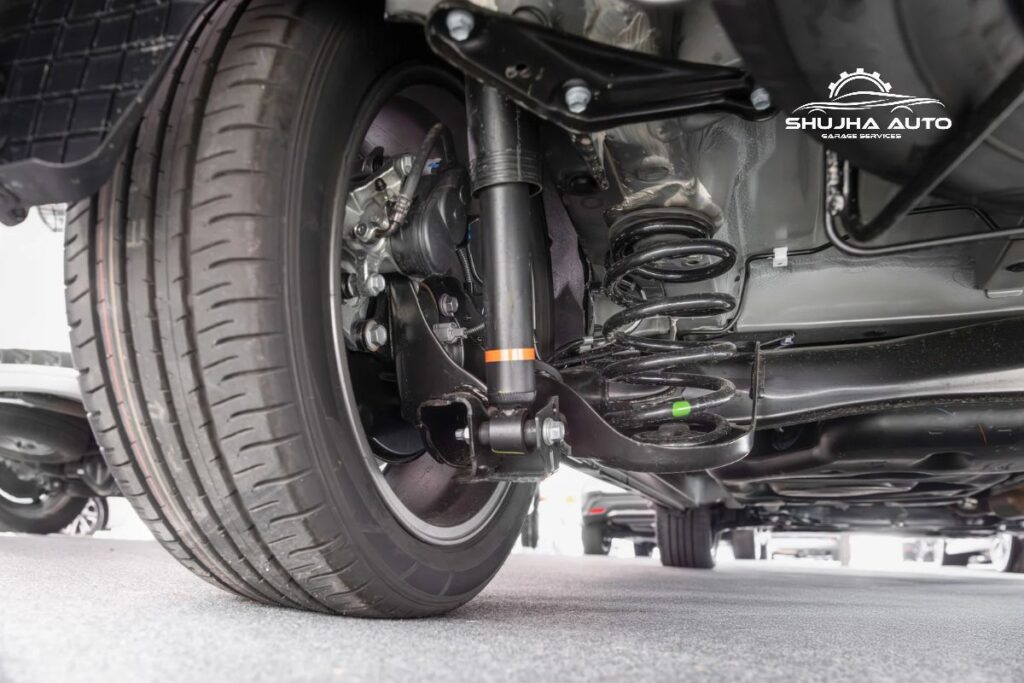
Common Parts of a Car Suspension System
Suspension systems can vary by vehicle, but many cars include similar parts.
Common suspension parts include:
- Shock absorbers
- Struts
- Coil springs
- Control arms
- Ball joints
- Bushings
- Stabilizer links
- Sway bar
- Tie rods
- Wheel bearings
- Mounts
- Suspension arms
If one part becomes weak, it can affect other parts. That is why suspension inspection should check the full system, not only one noisy component.
1. Bumpy or Rough Ride
A rough ride is one of the most common signs of bad suspension. If your car feels uncomfortable over small bumps, speed breakers, or rough roads, the shock absorbers or struts may be weak.
You may notice:
- Every bump feels strong
- Car shakes more than usual
- Ride feels hard or unstable
- Cabin vibration increases
- Car feels less smooth than before
Shock absorbers are designed to control movement. If they are worn out, the car cannot absorb road impact properly.
2. Knocking Noise Over Bumps
A knocking, clunking, or rattling sound when driving over bumps often points to suspension wear. This noise may come from stabilizer links, bushings, ball joints, control arms, struts, or shock mounts.
Common noise signs include:
- Clunk sound over speed bumps
- Rattle from front suspension
- Knocking when turning
- Metal sound on rough roads
- Noise from one side of the car
Suspension noise should not be ignored because a loose or worn part can affect vehicle control.
3. Car Pulling to One Side
If your car pulls left or right while driving straight, the suspension or wheel alignment may be affected. Sometimes tyre pressure can cause pulling, but suspension wear is also a common reason.
Possible causes include:
- Bad wheel alignment
- Worn control arm bushings
- Damaged suspension arm
- Uneven tyre pressure
- Bent suspension part
- Worn ball joint
- Accident damage
If the car pulls to one side after hitting a pothole or curb, get the suspension and alignment checked.
4. Uneven Tyre Wear
Bad suspension can cause tyres to wear unevenly. If the suspension does not hold the wheels correctly, the tyres may not touch the road evenly.
Look for:
- Tyre wear on one edge
- Patchy tyre wear
- One tyre wearing faster
- Cupping pattern on tyres
- Inner or outer tyre damage
Uneven tyre wear can also be caused by wheel alignment problems, worn steering parts, or poor tyre pressure. A proper inspection can confirm the real cause.
5. Car Bounces Too Much
A healthy car should settle quickly after going over a bump. If the car keeps bouncing up and down, the shock absorbers may be weak.
You may notice:
- Car bounces after speed breakers
- Rear side feels loose
- Front side dips and rises
- Car feels floating at highway speed
- Poor control on rough roads
Excessive bouncing reduces road grip and can make the car harder to control.
6. Nose Diving When Braking
Nose diving means the front of the car dips down too much when you brake. This can happen when front shocks or struts are weak.
Signs include:
- Front of car dips sharply during braking
- Longer stopping distance
- Car feels unstable when stopping
- Weight shifts too much to front
- Brake control feels poor
Bad suspension can affect braking performance, especially during sudden braking.
7. Body Roll While Turning
If your car leans too much when turning, the suspension may be weak. Some body movement is normal, but excessive leaning is a warning sign.
Possible causes include:
- Worn shock absorbers
- Weak struts
- Bad stabilizer links
- Damaged sway bar
- Worn bushings
- Weak springs
Body roll can reduce confidence and control while cornering.
8. Steering Vibration
Steering vibration can come from tyres, wheel balancing, alignment, steering components, or suspension parts. If the vibration happens while driving or braking, it should be checked.
Possible causes include:
- Worn suspension parts
- Bad wheel balancing
- Bent rim
- Uneven tyre wear
- Worn tie rods
- Bad ball joints
- Brake disc issues
If steering vibration gets worse at higher speeds, do not ignore it.
9. Leaking Shock Absorbers
Shock absorbers contain fluid that helps control movement. If the shock absorber leaks, it loses performance.
Signs of leaking shocks include:
- Oil marks on shock absorber
- Bumpy ride
- Excessive bouncing
- Poor handling
- Tyre wear
- Suspension noise
A leaking shock absorber usually needs replacement. Replacing shocks in pairs is often recommended for balanced performance.
10. Car Sitting Lower on One Side
If one side of your car sits lower than the other, there may be a spring or suspension issue. This can affect handling and tyre wear.
Possible causes include:
- Broken coil spring
- Weak spring
- Damaged strut
- Worn suspension mount
- Accident damage
- Heavy load damage
A car sitting unevenly should be inspected because it may affect stability.
11. Poor Handling at High Speed
Bad suspension can make your car feel unstable at higher speeds. The car may feel like it is floating, drifting, or not responding properly to steering.
Warning signs include:
- Car feels loose on highway
- Steering feels delayed
- Car moves too much in wind
- Poor grip during lane changes
- Unstable ride over bumps
High-speed instability can be dangerous and should be checked quickly.
12. Clunking Noise When Turning
A clunking sound during turning may be linked to suspension or steering parts. It may come from ball joints, tie rods, control arms, strut mounts, or CV joints.
If the noise happens when turning the steering wheel, parking, or making U-turns, the front suspension and steering system should be inspected.
13. Tyres Losing Grip
If your car feels like it loses grip easily, the suspension may not be keeping the tyres firmly on the road. This is especially noticeable on rough roads, curves, or during braking.
Poor tyre grip can happen due to:
- Weak shocks
- Worn suspension arms
- Bad bushings
- Uneven tyre wear
- Poor alignment
- Low-quality tyres
Suspension and tyre condition work together. Both should be checked for safe driving.
14. Car Feels Unstable After Hitting a Pothole
Potholes can damage suspension, steering, tyres, rims, and alignment. If your car feels different after hitting a pothole, get it inspected.
Watch for:
- Pulling to one side
- Steering vibration
- New knocking noise
- Tyre damage
- Bent rim
- Uneven steering wheel
- Suspension noise
Even if the damage is not visible, alignment or suspension parts may be affected.
15. Steering Wheel Not Straight
If your steering wheel is not straight while driving on a straight road, alignment or suspension damage may be present. This can happen after hitting a curb, pothole, or due to worn suspension parts.
A steering wheel off-center can cause tyre wear and poor control. Wheel alignment and suspension inspection are recommended.
What Causes Suspension Problems?
Suspension parts wear out over time. Driving conditions, road quality, vehicle load, and maintenance habits can affect how quickly suspension parts fail.
Common causes include:
- Rough roads
- Speed bumps
- Potholes
- Accident damage
- Worn shock absorbers
- Old bushings
- Weak springs
- Damaged ball joints
- Poor wheel alignment
- Heavy vehicle load
- Lack of inspection
- High mileage
In areas with rough roads, construction zones, and speed bumps, suspension parts may wear faster.
Is Bad Suspension Dangerous?
Yes, bad suspension can be dangerous because it affects control, braking, steering, and tyre grip. The car may still move, but it may not respond safely during emergency braking, sharp turns, or high-speed driving.
Bad suspension can increase risks such as:
- Longer braking distance
- Poor handling
- Loss of road grip
- Tyre damage
- Steering instability
- Vehicle pulling
- Sudden part failure
- Unsafe driving on rough roads
If your suspension is making noise or the car feels unstable, it is better to inspect it early.
Can You Drive With Bad Suspension?
You may be able to drive with mild suspension wear, but it is not recommended to ignore it. If the car is making loud knocking sounds, pulling heavily, bouncing too much, or feeling unstable, avoid long drives and get it checked.
Do not continue driving if:
- Suspension noise is very loud
- Steering feels loose
- Car pulls strongly
- Tyre is wearing badly
- Shock absorber is leaking
- Car sits lower on one side
- Handling feels unsafe
Driving with bad suspension can damage tyres and other parts.
What Happens During Suspension Inspection?
A proper suspension inspection helps identify the exact worn or damaged part. Guessing can lead to unnecessary repair.
At Auto Garage Services, suspension inspection may include:
- Shock absorber inspection
- Strut inspection
- Control arm check
- Ball joint inspection
- Bushing inspection
- Stabilizer link check
- Sway bar inspection
- Tie rod inspection
- Steering check
- Tyre wear inspection
- Wheel alignment check
- Underbody inspection
- Road test if needed
This helps confirm whether the problem is suspension-related, steering-related, tyre-related, or alignment-related.
Common Suspension Repairs
The correct repair depends on the inspection result.
Shock Absorber Replacement
If shocks are weak or leaking, replacement may be needed to restore ride comfort and control.
Strut Replacement
Struts support the vehicle and control movement. Bad struts can cause noise, bouncing, and poor handling.
Control Arm Replacement
A damaged control arm can affect wheel position, alignment, and stability.
Bushing Replacement
Bushings absorb vibration and allow controlled movement. Worn bushings can cause clunking noise and poor handling.
Ball Joint Replacement
Ball joints help the wheels move with the suspension and steering. A worn ball joint can be dangerous if ignored.
Stabilizer Link Replacement
Bad stabilizer links can cause knocking noise over bumps and increased body roll.
Wheel Alignment
After suspension repair, wheel alignment may be needed to prevent tyre wear and improve steering control.
How to Prevent Suspension Problems
You cannot avoid all suspension wear, but good habits can reduce damage.
Drive Carefully Over Speed Bumps
Slow down before speed bumps to reduce impact on shocks and springs.
Avoid Potholes When Possible
Potholes can damage suspension, tyres, rims, and alignment.
Do Not Overload the Car
Heavy loads put extra pressure on suspension parts.
Check Tyres Regularly
Tyre wear can reveal suspension and alignment problems.
Get Wheel Alignment Checked
Alignment helps protect tyres and suspension performance.
Inspect Suspension After Hard Impact
If you hit a pothole or curb, inspect the car even if it still drives.
Service the Car Regularly
Regular car maintenance helps find early suspension wear before it becomes serious.
Is Suspension Repair Expensive?
Suspension repair cost depends on the part, vehicle model, labour, and whether related parts are also damaged. Replacing stabilizer links or bushings may cost less than replacing struts, control arms, or multiple suspension parts.
The best way to know the cost is through inspection. Early repair can prevent extra tyre damage, alignment problems, and more expensive suspension failure.
Are There Any Hidden Fees or Charges?
A trusted garage should explain which suspension part is damaged and why it needs replacement. You should also know whether wheel alignment, tyre replacement, or additional parts are needed.
Auto Garage Services focuses on clear inspection and honest repair guidance, so customers understand the issue before approving the repair.
Free Diagnostic Check for Suspension Problems
If your car feels bumpy, noisy, unstable, or pulls to one side, a suspension inspection can help find the real cause. Suspension symptoms can come from shocks, struts, bushings, control arms, ball joints, tyres, alignment, or steering parts.
Auto Garage Services can inspect the suspension system, steering system, tyres, alignment, and underbody to identify the issue properly.
Why Choose Auto Garage Services?
Auto Garage Services provides suspension inspection, shock absorber replacement, strut inspection, control arm repair, ball joint inspection, bushing replacement, stabilizer link replacement, steering inspection, wheel alignment, tyre inspection, and complete car maintenance service.
If your car is making knocking sounds, feels bumpy, pulls to one side, or has uneven tyre wear, the team can inspect the vehicle and explain the problem in simple words.
Drivers choose Auto Garage Services because of experienced technicians, proper inspection process, clear communication, practical repair advice, and customer-focused service.
When Should You Visit Auto Garage Services?
You should visit Auto Garage Services if your car has suspension noise, bumpy ride, poor handling, steering vibration, uneven tyre wear, or car pulling to one side.
You should also visit if you notice:
- Knocking noise over bumps
- Leaking shock absorbers
- Car bouncing too much
- Nose diving while braking
- Body roll during turns
- Steering wheel not straight
- Car sitting lower on one side
- Tyres wearing unevenly
- Clunking noise when turning
- Unstable driving at high speed
Early suspension inspection can protect your tyres, steering system, and overall driving safety.
FAQs
1. What are the signs of bad suspension?
Common signs of bad suspension include a bumpy ride, knocking noise, uneven tyre wear, car pulling to one side, steering vibration, leaking shocks, excessive bouncing, nose diving while braking, and poor handling.
2. What does bad suspension sound like?
Bad suspension may make knocking, clunking, rattling, or squeaking sounds, especially when driving over bumps, turning, or passing speed breakers.
3. Can bad suspension cause uneven tyre wear?
Yes, bad suspension can cause uneven tyre wear because the tyres may not sit properly on the road. Alignment and steering issues can also contribute to uneven wear.
4. Is it safe to drive with bad suspension?
It may not be safe, especially if the car feels unstable, pulls to one side, bounces too much, or makes loud knocking sounds. Bad suspension can affect braking, steering, and road grip.
5. Why does my car bounce too much?
Excessive bouncing is often caused by worn shock absorbers or struts. These parts control body movement and help keep the tyres stable on the road.
6. Why does my car pull to one side?
Pulling can be caused by wheel alignment issues, tyre pressure differences, worn suspension parts, damaged control arms, or accident damage.
7. Can bad suspension affect braking?
Yes, bad suspension can affect braking by causing nose diving, reduced tyre grip, and longer stopping distance. Suspension and brakes both play a role in safe stopping.
8. How do mechanics check suspension problems?
Mechanics inspect shock absorbers, struts, control arms, bushings, ball joints, stabilizer links, tyres, steering parts, alignment, and underbody components.
9. When should suspension parts be replaced?
Suspension parts should be replaced when they are worn, leaking, loose, damaged, noisy, or affecting handling, tyre wear, or driving safety.
10. Does Auto Garage Services inspect suspension problems?
Yes, Auto Garage Services can inspect suspension problems. The team can check shocks, struts, control arms, bushings, ball joints, stabilizer links, steering parts, tyres, and wheel alignment.
Final Words
Bad suspension can make your car uncomfortable, noisy, unstable, and unsafe. Common signs include a bumpy ride, knocking noise over bumps, uneven tyre wear, car pulling to one side, steering vibration, leaking shocks, excessive bouncing, and poor handling.
Ignoring suspension problems can damage tyres, affect steering, increase braking distance, and reduce road safety. A proper inspection can help find the exact issue before it becomes more expensive.
If your car feels bumpy, makes suspension noise, pulls to one side, or does not handle properly, visit Auto Garage Services for suspension inspection, shock absorber replacement, steering inspection, wheel alignment, tyre inspection, and complete car maintenance service.