




Car AC Not Cooling Reasons include low refrigerant, faulty compressor, clogged filters, electrical issues, or condenser problems affecting cooling performance.
There’s almost nothing worse on a hot day than turning on your car’s air conditioner and feeling nothing but warm, stuffy air pour out. A malfunctioning car AC doesn’t just make driving uncomfortable; it can turn your vehicle into a sweltering metal box, making every journey a test of patience. If you’ve found yourself thinking, My car AC is not cooling properly, you’re not alone. It’s one of the most common complaints we hear at Shujha Auto Garage Services, especially as the mercury rises.
AC problems are diagnosable and repairable. You don’t need to suffer in silence or dread your commute. This comprehensive guide will walk you through the top reasons your Car AC is not cold, explain what’s really going on under the hood, and demystify the repair process. We’ll also tackle specific issues like your car AC not cooling at idle, a frustrating problem where the cool air vanishes when you’re stopped at a traffic light.
Most importantly, we want to empower you as a car owner. Understanding the potential causes helps you communicate clearly with your mechanic and make informed decisions about repairs. And if those repairs bring you to our door, we’ll explain exactly how we work—transparently, honestly, and with your comfort and safety in mind.
Understanding Your Car’s AC System: A Simple Breakdown
Before we dive into the problems, let’s quickly understand how the system works. Think of your car’s AC as a refrigerator on wheels. It’s a closed-loop system that circulates a special fluid called refrigerant. This refrigerant constantly changes from a liquid to a gas and back again, absorbing heat from inside your car and dumping it outside.
The key parts are:
- Compressor: The heart of the system. It pumps and pressurizes the refrigerant.
- Condenser: A radiator-like unit in front of your car’s engine radiator. It releases the heat from the refrigerant.
- Expansion Valve/Orifice Tube: A small device that controls the flow of refrigerant into the evaporator.
- Evaporator: A small radiator hidden behind your dashboard. This is where the magic happens—the refrigerant absorbs heat from the cabin air, cooling it down.
- Refrigerant: The special gas (commonly R-134a or the newer R-1234yf) that carries the heat.
- Fans: They blow air over the condenser and evaporator to aid heat exchange.
When any one of these components fails or underperforms, you get that dreaded blast of warm air. Let’s explore the culprits, starting with the most common.
Low Refrigerant Level (The Most Common Cause)
What’s Happening: Your AC system is sealed. It should never use up refrigerant like engine oil. If the refrigerant level is low, it means there’s a leak *somewhere* in the system. Without enough refrigerant, there simply isn’t enough material to absorb and carry away the heat.
Symptoms:
- AC blows cool, but not cold, especially on the hottest days.
- The air may start cold when you first turn it on, then gradually get warmer.
- You might hear the compressor clutch clicking on and off rapidly.
- A complete loss of cooling is possible if the refrigerant is very low.
How to Repair It:
A simple recharge or top-up from a DIY can is a tempting but often bad solution. It treats the symptom (low refrigerant) but ignores the disease (the leak). Putting in more refrigerant without fixing the leak is like pouring water into a bucket with a hole. It will just leak out again, wasting your money. More critically, refrigerant leaks are bad for the environment.
The Professional Repair: At Shujha Auto Garage Services, we follow a proper procedure:
- Recovery: We safely remove any remaining refrigerant from your system.
- Leak Detection: We use advanced tools like electronic leak detectors, UV dye, and nitrogen pressure testing to find the exact source of the leak. It could be a worn O-ring, a cracked hose, a faulty seal, or even a punctured condenser.
- Repair: We replace the faulty component. This is where an honest assessment is key. Sometimes it’s a simple, inexpensive seal; other times, it’s a more involved part replacement.
- Vacuum and Recharge: We pull a deep vacuum on the system for at least 30-45 minutes. This removes all air and moisture (which can turn into ice and cause major damage). Finally, we recharge the system with the exact amount of refrigerant specified by your vehicle’s manufacturer.
A Failing or Faulty Compressor
What’s Happening: The compressor is the workhorse. If it’s not working, the refrigerant isn’t moving, and no cooling can happen. Compressors can fail due to age, lack of lubrication (often caused by low refrigerant), or internal mechanical failure.
Symptoms:
- No cold air at all—only ambient-temperature air blows from the vents.
- Unusual noises (clunking, grinding, loud rattling) from the compressor when the AC is on.
- The compressor clutch (a pulley on the front of the compressor) does not engage when you turn the AC on. You can often see this by looking at the center of the pulley while the engine is running.
How to Repair It:
Compressor replacement is a significant repair. It’s also a system-critical job. A failing compressor often sends metal shavings throughout the entire AC system. Simply replacing the compressor without cleaning out this debris will cause the new compressor to fail quickly.
The Professional Repair: A proper compressor job includes:
- System Flushing: We flush the entire system—condenser, lines, evaporator core—to remove all contaminants.
- Replacement Parts: We install a new or remanufactured compressor. We also always replace the receiver-drier or accumulator (the system’s filter) and the expansion valve/orifice tube. These parts trap debris and moisture and must be new to protect the new compressor.
- Full Recharge: After another deep vacuum, we recharge the system with fresh refrigerant and oil.
Location: Please Visit Our Shujha Auto Garage
A Clogged or Blocked Cabin Air Filter
What’s Happening: This is often the simplest and most overlooked fix! The cabin air filter cleans the air before it goes over the cold evaporator coil and into your car. If it’s clogged with leaves, dust, and debris, it severely restricts airflow. Think of trying to breathe through a thick blanket. Even if the evaporator is ice-cold, no air can pass through to bring that coolness to you.
Symptoms:
- Weak airflow from the vents, even on the highest fan setting.
- The AC might feel somewhat cool but is utterly insufficient on a hot day.
- Musty odors from the vents.
How to Repair It:
This is the easiest and most cost-effective fix. The cabin air filter is usually located behind the glove compartment or under the dashboard. You can often check and replace it yourself by consulting your owner’s manual. If you’re not comfortable, any shop, including ours, can do it in minutes.
Problems with the Condenser or Cooling Fans
What’s Happening: The condenser’s job is to get hot—it releases the heat absorbed from your cabin. To do this effectively, it needs a strong flow of air passing through it. This comes from your car’s forward motion and, more importantly, from the cooling fans (radiator fans) that turn on when the AC is activated.
Symptoms:
- Car AC not cooling at idle or in slow traffic: This is a classic sign! When you’re moving, air is forced through the condenser. When you stop, you rely solely on the electric cooling fans. If they’re broken, the AC pressure will skyrocket, and cooling will stop until you start moving again.
- Poor cooling performance generally, especially on hot days.
- A visibly damaged or bent condenser (from road debris, rocks, etc.) will also block airflow.
How to Repair It:
- For Fan Issues: We diagnose the electric fan circuit. It could be a blown fuse, a bad relay, a broken fan motor, or a faulty temperature sensor. We repair or replace the specific failed component.
- For Condenser Issues: If the condenser is physically damaged or leaking, it must be replaced. This involves recovering the refrigerant, swapping the unit, and then recharging the system.
A Faulty Blend Door Actuator
What’s Happening: Inside your dashboard, a network of flaps called blend doors directs air. One critical door mixes hot air from the heater core with cold air from the evaporator to give you your desired temperature. If the actuator (the small electric motor that moves the door) fails or the door itself jams, it might be stuck sending hot air into your cold airstream.
Symptoms:
- Inconsistent temperatures—sometimes hot, sometimes cold.
- Air from some vents is cold, but from others (like the footwell) is hot.
- You may hear a repetitive clicking or knocking sound from behind the dashboard as the faulty actuator tries and fails to move.
How to Repair It: This is more of a dashboard repair than a traditional AC repair. The actuator must be located and replaced. This can range from an easy job behind the glove box to a more involved task requiring dashboard removal.
Electrical Issues (Fuses, Relays, Switches, Wiring)
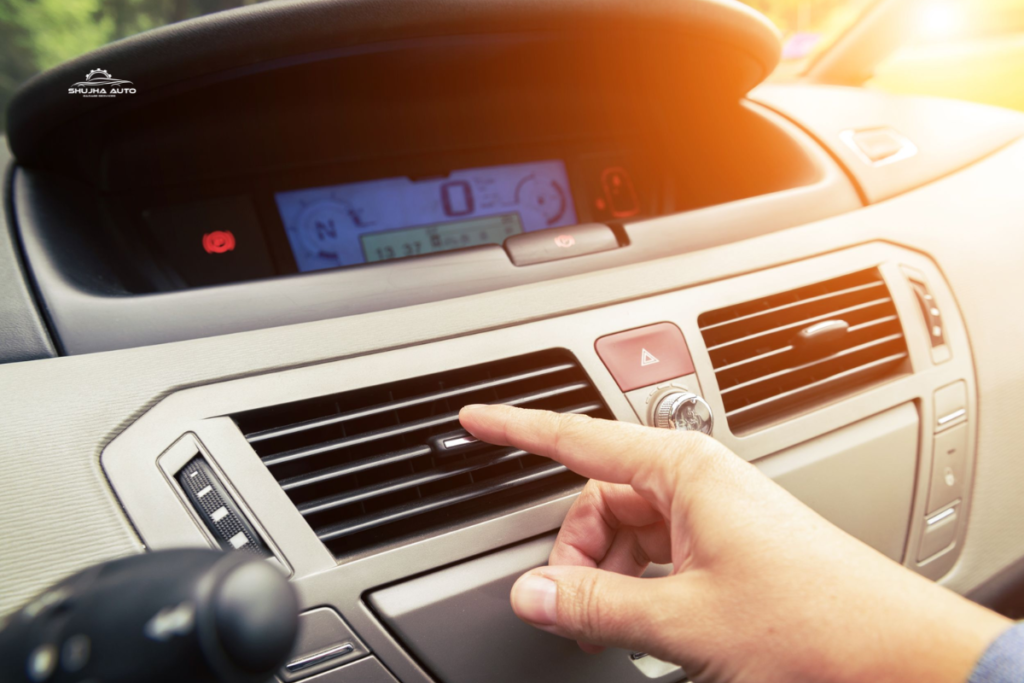
What’s Happening: The AC system relies on a network of electrical components to tell the compressor when to turn on, the fans when to spin, and the blower motor to push air. A simple blown fuse, corroded connector, or bad pressure switch can shut down the entire system.
Symptoms:
- The AC compressor does not engage at all (the clutch doesn’t pull in).
- The blower fan doesn’t work on any speed.
- The cooling fans don’t turn on.
How to Repair It: A systematic electrical diagnostic is needed. Using wiring diagrams and a multimeter, a technician will trace the circuit from the AC button on your dashboard all the way to the compressor clutch to find the break in the signal. We replace the faulty fuse, relay, switch, or repair the wiring as needed.
Moisture in the System (Clogged Orifice Tube)
What’s Happening: If moisture was not properly removed during a previous service, it can freeze inside the tiny orifice tube when the AC is running. This creates an ice block that stops refrigerant flow. Once you turn the AC off, the ice melts, and the system may work again… until it re-freezes.
Symptoms:
- AC works fine for a while, then slowly loses cooling until it blows warm air.
- After being off for 10-30 minutes, it works again, then fails again.
- You might see ice on the AC lines under the hood.
How to Repair It: The system must be evacuated with a high-quality vacuum pump for an extended period (sometimes over an hour) to boil off and remove all moisture. The orifice tube or expansion valve (which is often where the ice forms) should be replaced, and the receiver-drier/accumulator (which contains the moisture-absorbing desiccant) must be replaced.
What to Expect When You Bring Your Car to Shujha Auto Garage Services
We know that getting car repairs can be stressful. You’re worried about the cost, the time, and whether you’re being told the truth. We’ve built our reputation on eliminating that stress with a straightforward, transparent process.
The Free Diagnostic Check
When you come to us with a Car AC not cooling problem, we start with a free diagnostic check. This isn’t just a quick glance. Here’s what’s included:
- Visual Inspection: We check the compressor clutch operation, look for obvious leaks, inspect the condenser for damage, and ensure the cooling fans are working.
- Performance Test: We measure the temperature of the air coming from your center vent with a professional thermometer to quantify the problem.
- Pressure Gauge Reading: We connect manifold gauges to the high and low-side service ports. This tells us if the system is low on refrigerant, overcharged, or has a blockage. It’s a vital clue.
- Initial Assessment: Based on these findings, we give you a clear, plain-English explanation of what we believe is wrong.
This free check gives both of us a solid starting point. Sometimes, the problem is obvious from this step.
The Detailed Diagnosis
If the issue isn’t clear from the initial check, we’ll recommend a more detailed diagnosis. This is where we pinpoint the exact cause. We might:
- Add UV dye to the refrigerant to find minute leaks.
- Perform an electronic leak detection scan of the entire system.
- Check electrical signals to actuators, switches, and the compressor clutch.
- Use a boroscope to look inside ductwork if a blend door is suspected.
What happens if an issue is found? We stop all work and contact you immediately. We will explain the problem in detail, show you any visual evidence (like UV dye at a leak point), and provide a written, itemized estimate for your approval. No work is ever started without your full and informed consent.
Repair, Transparency, and Peace of Mind
Once you approve the estimate, our certified technicians get to work. We use quality parts and follow manufacturer procedures. During the repair, if we discover any additional, necessary issues that weren’t visible initially (a common scenario in AC work), we will call you again, explain the new situation, and get your approval before proceeding.
Are there any hidden fees or charges? No. The price on your approved estimate is the price you pay. We believe surprise fees destroy trust. Our final invoice will match the estimate unless you have specifically approved an additional, clearly explained repair.
Prevention: Keeping Your Car’s AC Cold
The best repair is the one you avoid. Here are simple tips:
- Run it Regularly: Run your AC for at least 5-10 minutes once a week, year-round. This keeps the seals lubricated and the compressor in good shape.
- Get it Serviced Periodically: Consider a professional AC check-up every two years. A technician can spot small issues before they become big, expensive failures.
- Change the Cabin Air Filter: Do this annually or as your manual recommends. It ensures good airflow and air quality.
- Park in the Shade: When possible, it reduces the initial heat load on the system.
Don’t Sweat It This Summer
A broken car AC can ruin your day, but it doesn’t have to ruin your week or your wallet. By understanding the reasons your car AC is not cold, you’re already a step ahead. Whether it’s a simple filter swap or a more complex compressor repair, the key is accurate diagnosis and honest service.
If you’re in the area and struggling with an AC that’s blowing warm air, whether it’s a general issue or the specific frustration of a car AC not cooling at idle, remember that help is just around the corner. At Shujha Auto Garage Services, we’re here to get you cool, comfortable, and back on the road with confidence. Give us a call or stop by. Let’s turn that hot air into a refreshing, cool breeze together.