


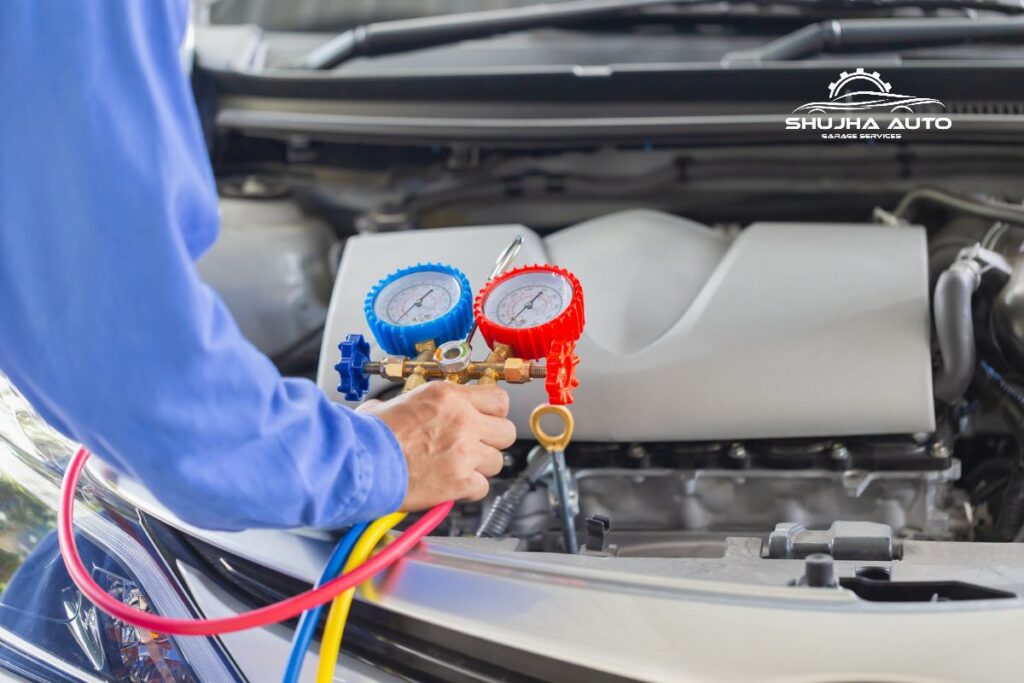
Car AC gas running out quickly is a frustrating problem, especially when you have recently refilled the refrigerant and expected your air conditioning to work properly for a long time. You may notice that your car AC cools perfectly after a gas refill, but within a few days, weeks, or months, the cooling becomes weak again.
Many drivers assume that car AC gas naturally finishes because the air conditioner is used daily. However, that is not how a healthy car AC system works.
Car AC refrigerant circulates inside a sealed system. It does not get consumed like petrol or diesel. If your car AC repeatedly loses refrigerant, there is likely a leak, an incorrect previous recharge, or another problem that needs professional diagnosis.
In the UAE, where temperatures can become extremely high, weak car AC cooling can make driving uncomfortable. Ignoring refrigerant leakage may also lead to expensive compressor repairs and further AC system damage.
In this guide, we will explain why car AC gas runs out quickly, common refrigerant leak locations, warning signs, repair options, and when to visit Auto Garage Services in Sharjah for car AC leak detection, AC gas refilling, compressor inspection, condenser repair, and complete car AC service.
Quick Answer: Why Is Car AC Gas Running Out Quickly?
Car AC gas usually runs out quickly because refrigerant is leaking from the air conditioning system.
Common causes include damaged AC pipes, worn O-ring seals, leaking compressor seals, condenser damage, evaporator leaks, faulty service valves, and loose or deteriorated connections.
A small amount of refrigerant may gradually escape from an aging system over several years, but rapid or repeated refrigerant loss is not normal.
If your car AC becomes warm again shortly after a gas refill, simply adding more refrigerant is not a permanent solution. The system should be checked for leaks, repaired, and recharged with the correct type and quantity of refrigerant.
Does Car AC Gas Actually Finish?
One of the biggest misunderstandings about automotive air conditioning is that refrigerant gets used up during operation.
Car AC gas, technically called refrigerant, circulates through the compressor, condenser, expansion device, and evaporator. It absorbs heat from the cabin and releases that heat outside.
The refrigerant changes between liquid and gas during this process, but it is not burned or consumed.
In a properly functioning sealed system, refrigerant should remain inside the AC circuit.
Over time, some vehicles may develop minor refrigerant losses through aging hoses, seals, and connections. However, a car requiring frequent AC gas refills should be inspected for leakage.
Important: Driving with the AC switched on throughout the day does not directly consume refrigerant. Heavy AC usage can reveal an existing problem, but it does not explain rapid gas loss by itself.
Common Causes of Car AC Gas Running Out Quickly
Several components can allow refrigerant to escape. Understanding these possible causes helps you avoid repeatedly paying for AC gas refilling without solving the actual problem.
1. Car AC Refrigerant Leak
A refrigerant leak is the most likely reason your car AC gas keeps getting low.
The AC system includes pipes, connections, valves, seals, and other components that must hold refrigerant under pressure.
Over time, vibration, aging, corrosion, temperature changes, or physical damage can create small openings.
Common signs of refrigerant leakage include:
- AC cooling becoming weak after refilling
- Warm air from the vents
- Cooling that gradually worsens
- Oily residue around AC connections
- Abnormal compressor cycling
- Reduced cooling in traffic
- AC performance changing unexpectedly
Some refrigerant leaks are very small and difficult to detect without specialized equipment.
Solution: Have the air conditioning system professionally tested to identify and repair the leak before recharging it.
2. Damaged AC Condenser
The AC condenser is usually located near the front of the vehicle, close to the radiator.
It releases heat from the refrigerant as part of the cooling process.
Because of its location, the condenser is exposed to road debris, dust, moisture, stones, and other environmental conditions.
A small stone impact or corrosion can damage the condenser and create a refrigerant leak.
Signs of condenser problems include:
- Weak AC cooling
- Refrigerant loss
- Visible condenser damage
- Oily marks around the condenser
- Cooling problems after a front-end impact
In UAE driving conditions, road debris and dust can also reduce condenser efficiency, although blocked fins alone do not cause refrigerant gas to disappear.
Solution: Inspect the condenser for leaks and damage. A leaking condenser may need replacement.
3. Worn AC Compressor Seals
The AC compressor is responsible for circulating refrigerant throughout the system.
Compressor shaft seals, housing seals, or connection points can develop leaks as the components age.
If refrigerant escapes around the compressor, the system may lose cooling performance.
Possible signs include:
- Refrigerant loss after refilling
- Oily residue near the compressor
- Weak or inconsistent cooling
- Unusual compressor noise
- Compressor-related faults
Not every compressor leak requires replacing the entire compressor. The correct repair depends on the component design, damage, and inspection results.
Solution: Have the compressor and its connections inspected before deciding whether seal repair, component replacement, or complete compressor replacement is required.
4. Damaged AC Pipes and Hoses
The refrigerant travels through AC pipes and flexible hoses.
These components experience vibration, engine movement, temperature changes, and pressure fluctuations.
Over time, rubber hoses can deteriorate and metal pipes can become damaged or corroded.
Common causes of pipe leakage include:
- Cracked rubber hoses
- Loose connections
- Worn hose crimps
- Corroded metal pipes
- Accidental damage during repairs
- Excessive rubbing against nearby components
A damaged hose or pipe can slowly release refrigerant and cause repeated cooling problems.
Solution: Inspect the refrigerant lines, repair or replace damaged components, and check the system for additional leaks.
5. Worn O-Rings and Rubber Seals
O-rings are small rubber seals used at many refrigerant connections.
Although these parts are inexpensive, a damaged O-ring can cause significant AC gas leakage.
Rubber seals may deteriorate because of age, heat exposure, poor installation, or unsuitable replacement parts.
You may notice refrigerant loss after previous AC repair if a connection was not sealed correctly.
Solution: A technician should inspect suspected joints and replace damaged seals with parts compatible with the vehicle’s refrigerant and AC oil.
6. Faulty AC Service Valves
AC service ports are used when checking, recovering, or recharging refrigerant.
These ports contain valves that should seal properly after servicing.
If a valve core becomes worn, damaged, or contaminated, refrigerant may escape.
Sometimes leakage appears shortly after AC gas refilling because of a problem at the service connection.
Solution: Check the service ports and valve cores for leakage. Faulty components should be repaired or replaced using appropriate refrigerant-handling procedures.
7. Leaking AC Evaporator
The evaporator is usually located inside the dashboard’s air conditioning housing.
It absorbs heat from cabin air and helps create the cooling you feel through the vents.
Over time, the evaporator may develop leaks because of corrosion, aging, or physical damage.
Evaporator leaks can be harder to diagnose because the component is not easily visible.
Possible signs include:
- AC cooling becoming weak repeatedly
- Refrigerant loss without a visible engine-bay leak
- Poor cooling despite previous repairs
- A leak detected near the evaporator housing or drain
A bad smell from the vents is not proof of an evaporator refrigerant leak; it can also result from moisture or microbial buildup.
Solution: Professional leak detection can help determine whether the evaporator is leaking. Replacement may require dashboard disassembly on some vehicles.
8. Improper AC Gas Refilling
Sometimes a car appears to be losing refrigerant because the previous recharge was incorrect.
Every car AC system has a specified refrigerant type and charge quantity.
If the system receives too little refrigerant, cooling performance may remain weak.
If too much refrigerant is added, the system may experience abnormal pressures and reduced cooling efficiency.
An incorrect charge can also make diagnosis confusing.
Solution: The refrigerant charge should be checked and restored according to manufacturer specifications using suitable service equipment.
A correct recharge does not replace the need to repair any existing leaks.
9. Previous AC Repairs or Incorrect Installation
AC gas leakage can also occur after repair work.
If a pipe connection, condenser, compressor, or other component was installed incorrectly, the system may not seal properly.
Potential problems include:
- Damaged O-rings
- Loose fittings
- Incorrect replacement seals
- Damaged pipe connections
- Improperly installed components
- Unresolved leaks after repair
If AC cooling became weak soon after replacing a component, the repaired area should be inspected first.
Solution: Check previous repair locations and perform a complete leak test before recharging.
Signs Your Car AC Gas Is Getting Low
Refrigerant loss can affect AC cooling in several ways.
AC Blowing Warm Air
One of the most noticeable symptoms is warm air coming from the vents.
If your AC previously cooled properly but now struggles to lower cabin temperature, low refrigerant may be responsible.
However, warm air can also result from compressor faults, condenser fan problems, electrical issues, or blocked airflow.
AC Cooling Becoming Weak Gradually
A slow leak may allow the AC to work normally for some time before cooling becomes weaker.
You may notice that the AC takes longer to cool the cabin or performs poorly during hotter parts of the day.
AC Stops Cooling After Refilling
If cooling improves immediately after a refrigerant recharge but disappears again within a short period, a leak is a strong possibility.
A professional leak test is recommended instead of another temporary refill.
Compressor Cycling Abnormally
Some car AC systems may switch the compressor on and off differently when refrigerant pressure is outside its normal operating range.
Frequent cycling can indicate a refrigerant problem, but it can also be related to sensors, electrical controls, or other faults.
Hissing Noise
A refrigerant leak may occasionally produce a hissing sound.
However, not every hiss from a car AC system indicates leakage. Some sounds are normal during pressure equalization after the AC switches off.
Persistent or unusual sounds should be inspected.
Why Does Car AC Gas Finish After One Week?
If your car AC stops cooling only one week after refilling, that is not normal.
A significant refrigerant leak is one possible explanation.
The leak may be located at the condenser, compressor, pipes, O-rings, evaporator, or service valves.
An incorrect initial recharge can also cause poor cooling.
In this situation, avoid paying for repeated gas refills without a diagnosis. Ask for refrigerant leak detection and a full AC system inspection.
Why Does Car AC Gas Finish Every Few Months?
If your car AC needs refrigerant every two or three months, there may be a slower leak.
Small leaks can be difficult to identify during a quick inspection.
They may occur only under particular temperatures or operating pressures.
A technician may need to use an electronic leak detector, UV dye, or an appropriate pressure-testing method to locate the fault.
A properly repaired system should not need repeated recharging on a routine short-term schedule.
Does UAE Summer Heat Make Car AC Gas Finish Faster?
This is a common question among drivers in Sharjah and Dubai.
High temperatures make the AC work harder because the system must remove more heat from the vehicle’s interior.
However, heat does not directly consume refrigerant.
UAE conditions can contribute indirectly to problems such as aging rubber seals, reduced condenser efficiency, and greater stress on already damaged components.
Dust buildup can also reduce airflow through the condenser, causing weaker cooling.
If your car AC becomes less effective during summer, it does not automatically mean the refrigerant is low.
The system should be checked before adding gas.
Can a Dirty Cabin Filter Cause AC Gas Loss?
No. A dirty cabin air filter does not directly cause refrigerant to escape.
The cabin filter removes dust and particles from the air entering the vehicle.
When the filter becomes blocked, airflow through the vents may decrease.
This can make the AC feel weak even when the refrigerant charge is correct.
Common signs of a dirty cabin filter include weak airflow, dust from vents, unpleasant smells, or difficulty cooling the cabin.
Solution: Inspect and replace the cabin filter if necessary. Do not refill refrigerant based only on weak airflow.
Can Low AC Gas Damage the Compressor?
Yes, operating an AC system with insufficient refrigerant can contribute to compressor problems.
Automotive air conditioning systems use specialized lubricant that circulates through the system with the refrigerant.
Significant refrigerant loss can affect lubrication and operating conditions.
Depending on the system, protective controls may reduce or stop compressor operation when pressure becomes too low.
However, continuing to operate a faulty system can increase the risk of expensive damage.
If your AC has a confirmed refrigerant leak, it is better to repair the problem rather than repeatedly refilling it.
How Mechanics Find Car AC Gas Leaks
Finding the exact leak is the most important part of solving repeated refrigerant loss.
A professional diagnosis may involve several steps.
AC Cooling Performance Test
The technician checks vent temperatures, airflow, compressor operation, and system behaviour.
This helps determine whether the problem is likely related to refrigerant loss or another AC component.
Refrigerant System Inspection
The technician inspects the condenser, compressor, hoses, service valves, and visible connections for damage or signs of leakage.
Electronic Leak Detection
An electronic refrigerant leak detector can help locate escaping refrigerant, including leaks in difficult-to-reach areas.
UV Dye Inspection
Compatible fluorescent dye may be used to identify leaks.
When dye escapes with refrigerant and compressor oil, it can become visible under a suitable UV lamp.
Pressure Testing
Approved pressure-testing methods can help identify leaks when appropriate.
Testing must be carried out using suitable equipment and procedures for the refrigerant system.
Repair Confirmation
After the leaking component is repaired, the system should be checked again before receiving the correct refrigerant charge.
AC Gas Refilling vs AC Leak Repair
Many drivers confuse refrigerant refilling with repairing an AC problem.
These are different services.
AC Gas Refilling
AC gas refilling restores the refrigerant charge.
It may improve cooling if refrigerant was low, but it does not repair damaged components or stop refrigerant from escaping.
AC Leak Repair
AC leak repair involves finding the point where refrigerant is escaping and fixing the affected component.
This may require replacing a seal, hose, condenser, service valve, evaporator, or another component.
Once the leak is repaired, the system can be evacuated and recharged according to manufacturer specifications.
The better long-term solution is to diagnose and repair leakage before recharging the system.
Is It Safe to Refill Car AC Gas at Home?
Car AC systems contain pressurized refrigerant and require the correct equipment for safe servicing.
Using an unsuitable refrigerant or adding an unknown quantity can damage the AC system or reduce cooling performance.
Some refrigerants also require particular handling precautions.
Avoid opening refrigerant lines, releasing gas into the atmosphere, or using unapproved refrigerant mixtures.
A professional AC technician should handle refrigerant recovery, leak repair, evacuation, and recharging.
How to Prevent Car AC Refrigerant Leaks
Not every refrigerant leak can be prevented, but regular care can help identify problems early.
Inspect the AC System Regularly
Arrange an AC inspection if you notice declining cooling performance or unusual AC noises.
Keep the Condenser Clean
Dust and debris can reduce condenser efficiency. Cleaning should be performed carefully to avoid damaging the delicate fins.
Repair Small Leaks Early
A minor leak can become more expensive if ignored.
Use Correct Refrigerant
Always use the type specified by the vehicle manufacturer. Different refrigerants should not be mixed unless the system has been properly designed and approved for that application.
Replace Damaged Seals and Hoses
Aging connections and damaged refrigerant lines should be repaired when leakage is confirmed.
Avoid Repeated Gas Top-Ups
If your AC loses refrigerant repeatedly, prioritize leak diagnosis rather than treating another refill as permanent maintenance.
How Often Should Car AC Gas Be Refilled?
There is no universal schedule requiring car AC refrigerant to be refilled every six months or every year.
A healthy system should retain its charge for a long period.
Some vehicles may develop gradual refrigerant loss over several years, but frequent refilling is not normal maintenance.
If your car AC stops cooling, the cause should be diagnosed before deciding that refrigerant is needed.
For UAE drivers, checking AC performance before summer is sensible, but that does not mean the system automatically needs a gas refill.
Is Car AC Leak Repair Expensive in Sharjah?
Car AC leak repair costs depend on where the leak is located and which components require replacement.
For example, replacing a damaged O-ring or accessible pipe connection may be relatively straightforward.
Replacing a condenser, compressor, or evaporator may involve greater parts and labour costs.
The total price may depend on:
- Vehicle make and model
- Leak location
- Replacement parts
- Labour requirements
- Refrigerant type and quantity
- Required diagnostic tests
- Additional AC system damage
An accurate quotation should follow an inspection.
Repairing the correct component is generally better than repeatedly paying for temporary refrigerant refills.
Are There Any Hidden Fees or Charges?
Before approving AC repairs, ask the garage what the quotation includes.
Confirm whether diagnosis, leak detection, replacement parts, refrigerant recovery, recharging, and final cooling tests are included or charged separately.
Some repairs may reveal additional problems once the system is inspected.
A clear explanation of the diagnosis and expected cost helps you make an informed repair decision.
Why Choose Auto Garage Services?
Auto Garage Services provides car AC repair and inspection services in Sharjah for drivers experiencing weak cooling, refrigerant leakage, compressor problems, condenser faults, and related air conditioning issues.
If your car AC gas keeps getting low, the team can assess the system and recommend the appropriate next steps.
Rather than assuming every cooling problem requires gas refilling, a proper inspection helps identify whether the fault involves refrigerant leakage, the compressor, condenser, evaporator, cooling fan, or electrical controls.
Auto Garage Services is located in Al Sajaah, Emirates Industrial City, Sharjah, making it an option for drivers looking for car AC repair services in Sharjah and nearby areas.
When Should You Visit Auto Garage Services?
You should arrange an AC inspection if your car repeatedly loses cooling after refrigerant refilling.
Other signs that require attention include:
- AC gas becoming low within weeks
- Warm air coming from vents
- Weak cooling during hot weather
- Visible oil residue on AC components
- Unusual compressor noise
- Frequent cooling interruptions
- Refrigerant leakage after repair
- AC cooling poorly while idling
- Repeated AC gas refill requirements
Early diagnosis can help prevent larger repair expenses.
For car AC inspection, AC refrigerant leak detection, gas refilling, condenser inspection, compressor repair, and related AC services, contact Auto Garage Services in Sharjah.
FAQs
1. Why does car AC gas run out quickly?
Car AC gas usually runs out quickly because of refrigerant leakage. Common leak locations include condenser connections, compressor seals, AC pipes, O-rings, service valves, and evaporator components. Incorrect previous recharging can also cause poor cooling.
2. Is it normal for car AC gas to finish every year?
No. Car AC refrigerant is not consumed during normal operation, so an annual refill is not automatically required. Frequent refrigerant loss may indicate leakage or another system issue.
3. Why does car AC gas finish after one week?
If cooling disappears one week after refilling, a significant leak or incorrect recharge may be responsible. Professional inspection is needed to confirm the cause.
4. Can a car AC condenser cause gas leakage?
Yes. Condenser corrosion, stone impacts, or physical damage can create refrigerant leaks. A damaged condenser may require replacement.
5. Can a compressor leak AC gas?
Yes. Refrigerant may escape through compressor shaft seals, housing connections, or other damaged sealing areas. The compressor should be inspected before replacing parts.
6. Does car AC gas finish faster in hot weather?
No. Hot weather does not directly consume refrigerant. However, high temperatures can place additional demands on the AC system and make existing faults more noticeable.
7. Can a dirty cabin filter cause low AC gas?
No. A dirty cabin filter can reduce airflow and make cooling feel weak, but it does not directly cause refrigerant loss.
8. How do mechanics find car AC refrigerant leaks?
Mechanics may use electronic refrigerant leak detectors, compatible UV dye, visual inspection, and appropriate pressure-testing methods to identify leaking components.
9. Is refilling AC gas without repairing the leak a good idea?
No. Recharging may temporarily restore cooling, but refrigerant will escape again if the underlying leak remains. Repairing the leak provides a more reliable long-term solution.
10. Can low AC gas damage the compressor?
Yes. Significant refrigerant loss can affect compressor operating conditions and lubrication. Prolonged operation with a faulty refrigerant system may contribute to compressor damage.
11. How long should car AC gas last?
A properly functioning system should retain refrigerant for a long time. There is no fixed refill interval for every car. Rapid refrigerant loss requires diagnosis.
12. Does Auto Garage Services provide car AC leak repair in Sharjah?
Auto Garage Services provides car AC repair and inspection services in Sharjah, including services related to weak cooling, refrigerant problems, compressors, condensers, and other AC components.
Final Words
Car AC gas running out quickly is usually a sign that something is wrong with the air conditioning system.
Unlike engine fuel, refrigerant does not get consumed during normal AC operation. If it repeatedly becomes low, the system may have a leak in the condenser, compressor, pipes, seals, service valves, or evaporator.
Repeated gas refilling may restore cooling temporarily, but it does not solve the actual problem.
The best approach is to have the AC system inspected, locate the cause of refrigerant loss, repair the damaged component, and recharge the correct amount of refrigerant.
If your car AC gas keeps getting low or your air conditioner stops cooling shortly after refilling, visit Auto Garage Services in Al Sajaah, Sharjah, for car AC inspection, leak diagnosis, AC repair, refrigerant refilling, compressor inspection, and related car maintenance services.
Book a car AC inspection with Auto Garage Services before a small refrigerant leak becomes a more expensive repair.